Physics Notes: Cosmology
and Black Holes
Lecture 2: Jan 17, 2011 Back to PHY33
Topics: Metric of black hole, light ray space-time path, temperature/entropy relationship to area of horizon
We lost time waiting for the room to be unlocked, so the usual Q&A session at the beginning of class was skipped.
Lecture Start
The Metric of a Black Hole
Black Holes are one of the success stories of string theory. They were thought to violate known laws of physics, but turned out not to.
In order to understand space near a black hole we need understand the geometry of space-time. A good place to start is the calculation of the separation of two events.
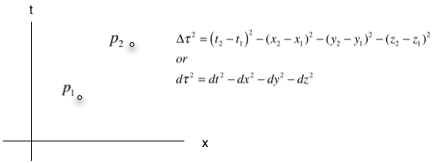
Tau stands for the proper time, and would be the difference in readings of a clock transported from event p1 to event p2. The t,x,y,z values are the times and position coordinates that an observer would give to the two events. Different observers in different positions and different velocities would have different values for the coordinates of the two events, but everyone would see the same value on the face of the clock when it was at p1 and again at p2, so everyone (all observers) would see the same proper time difference between the two events.
The equations to the right of the graph give the way to compute the square of the proper time from an observer’s coordinates.
In general relativity the proper time computation generalizes to

In this equation we are using Einstein summation notation where there is an implicit sum across repeated upper and lower indices. The tensor g has 16 components.
Where g is known as the metric tensor. We can formulate the special relativity distance in this way since it is just a special case. The metric tensor will be:

A key question is to determine the path of light rays. We can do this by simply requiring the proper time along the path to be 0.
As a first step to describing the metric near a black hole
we need to switch to polar (or spherical) coordinates where a location is
specified as  . r
is the distance from the origin,
. r
is the distance from the origin,  is the
angle from the pole, and
is the
angle from the pole, and  is the
angle in the x-y plane. The proper time equation for
special relativity then looks like
is the
angle in the x-y plane. The proper time equation for
special relativity then looks like

Where  is used
to summarize angular distances. This works because the Schwarzschild black hole
is symmetric, and will simplify our equations.
is used
to summarize angular distances. This works because the Schwarzschild black hole
is symmetric, and will simplify our equations.
In the presence of a black hole the metric has to be modified. Far away from the black hole it should reduce to the simple form above. A useful parameter in describing a black hole is the radius of the event horizon.

Using this parameter the metric near a black hole takes the form

We won’t derive this now; instead we want to look at the consequences.
Far away from the black hole the added coefficients go to 1 as required.
When  the point
is inside the horizon (inside the BH). This flips the sign for
the point
is inside the horizon (inside the BH). This flips the sign for  .
When
.
When  , the dt2 coefficient goes to
0, but the dr2 coefficient goes to infinity. We will come back to
this. When
, the dt2 coefficient goes to
0, but the dr2 coefficient goes to infinity. We will come back to
this. When  , the dt2 coefficient goes to
infinity.
, the dt2 coefficient goes to
infinity.
If you are falling into a black hole, then different parts of your body will experience differences in gravity, otherwise known as tidal forces. At the horizon of the black hole the tidal forces decrease. At the center, they go to infinity.
Suppose that we have a light ray moving directly outwards
from a black hole. In this
case  , so we have

or


This last expression gives the velocity in this coordinate system for light moving outward (+) or inward (-).
Near the horizon, we can see that


Inside a black hole, all light rays fall inward.
Q: I thought the velocity of light was always c?
A: In these coordinates, the units of r are being changed. The right way to think about light paths is that the proper time along them is 0.
The Quantum Mechanics of Black Holes
Stephen Hawking claimed
that anything that falls into (onto sounds like a better term) a black hole is
lost, including information. As we saw in the previous section, light
or objects falling towards the horizon only approach the horizon, but don’t
reach it. [This is where I had a bit of a problem – when a second
mass comes along, it should increase the radius to overlap the position of the
first mass. I asked this
question, but apparently the increase of radius changes the coordinate system
in such a way that he first mass is still outside of the horizon.]
Black holes are black in the sense that they emit thermal radiation. Undisturbed black holes will eventually radiate away all their mass. So what happens to the information that was dropped in while building the black hole?
What is information and how do you quantify it? Imagine a grid

Fact: Information never disappears. Distinct starting conditions evolve
into distinct ending conditions.
[In a prior class, Prof Susskind also pointed
out that this means you can run the state evolution backwards in a unique way.]

Sometimes it looks like information disappears. For example, when we drop one drop of water into a bathtub, there is initial information about the velocity and location of impact, but after a short time the bathtub looks the same regardless of the location and variation in velocity of the impact. The information is there, but is hidden in the degrees of freedom of the water in the bathtub. These degrees of freedom include exchanges of molecules and their motions. This kind of hidden or inaccessible information is what we call Entropy. Entropy is the number of hidden bits of information.
Entropy and energy are basic properties of systems. Temperature is something that seems intuitive – it is what we measure with a thermometer (or our finger).

One way to think about this equation is that T is a measure of the amount of energy you have to add to add a bit of information to a system.
As an aside, there is a connection to computation. Energy in a computer must be moved to the heat bath (the air) when information is erased. This equation tells us what the minimum energy loss is in non-reversible computation.
Let’s apply this notion of adding bits of information to a black hole. The idea is to drop objects that have only a single bit of information onto the black hole and see how it changes. Suppose we send a photon towards a black hole. The location of impact carries information. The way to get around this is to make the wavelength of the photon be about the same length as the radius of the black hole, and then it won’t have a location on the black hole. If the photon has a longer wavelength than this, it can be shown the photon will be reflected.
This process and the result were covered in lecture 5 of Statistical Mechanics, so I am just going to reference it.
And that’s it!