Physics Notes: Cosmology
and Black Holes
Lecture by Professor Leonard Susskind
Lecture 3: Jan 24, 2011 Back to PHY33
Topics: Black hole metric near the horizon, temperature and lifetime of black holes.
Q: The question was about the details of building a black hole one bit at a time. I arrived in the middle so I think the question had to do with the real information content of photons or gravitons. In the derivation of the area/entropy relationship we assumed that the photons carried one bit of information.
A: There are
actually two bits of information.
Is the photon there, and if so, then what is its polarization? [I suppose that
there are really  because there are only 3 states. The state “not present” does not
include polarization sub states.]
because there are only 3 states. The state “not present” does not
include polarization sub states.]
Gravitons could also be used to build the black hole.
Lecture Start
The horizon is not a “dangerous” place. An infalling observer would observe nothing special about it. Points just outside and inside would appear the same. This is not clear from the metric (and coordinates) we used for the space-time around a black hole.
 where
where 
[Note:
The radius here is not the distance from the center, since that is not well
defined, it is the value that would yield the horizon area in the standard equation
for the area of a sphere.]
To show this we will change
to a coordinate system that makes it clear that  is not a
physical discontinuity. [It is a coordinate system discontinuity for our first
coordinates.] To start, we will restate the metric in
terms of the proper distance instead of proper time.
is not a
physical discontinuity. [It is a coordinate system discontinuity for our first
coordinates.] To start, we will restate the metric in
terms of the proper distance instead of proper time.

One advantage of using proper distance is that for space-like event separations that the proper distance will be real. We tend to choose the formulation that is simpler for our problem.
Now let’s express the proper distance in flat x-y space.
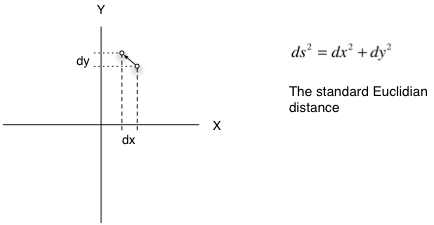
We can convert to polar coordinates
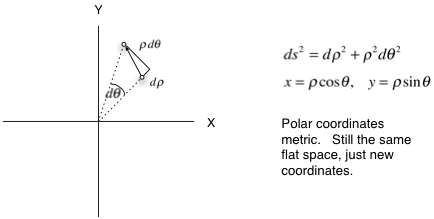
Notice that if  , then changes in
  don’t
change the proper distance, much like what happens to
don’t
change the proper distance, much like what happens to  when
when  in the
black hole metric.
in the
black hole metric.
Now let’s change to Minkowski space-time.
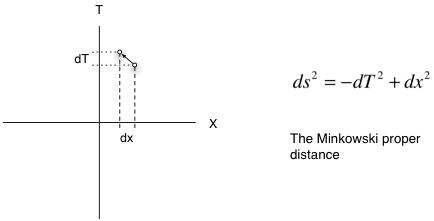
There is an equivalent to polar coordinates where we use a hyperbolic angle.
[ A
little background on hyperbolic functions …


So
the hyperbolic sinh and cosh functions are closely related to the normal sin
and cos functions. Changing
to sinh/cosh compensates for the sign change in Minkowski space-time. ]
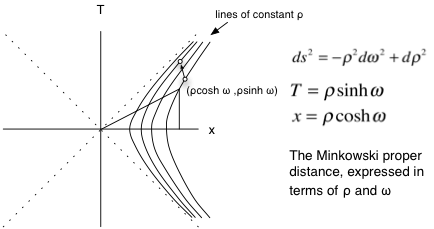
The hyperbolic angle  expresses
the position along the line of constant
expresses
the position along the line of constant  , and ranges from –infinity to +infinity. It is a kind of time variable, which can see in the sign
of the contribution to the proper distance.
, and ranges from –infinity to +infinity. It is a kind of time variable, which can see in the sign
of the contribution to the proper distance.
A particle following one of
the lines of constant  in flat space is under constant acceleration. The dotted lines are the light
paths from the origin.
in flat space is under constant acceleration. The dotted lines are the light
paths from the origin.
Now let’s go back to the
Schwarzschild metric for the black hole. The first thing is to reorganize so that
the places we are taking differences between r and  are
explicit.
are
explicit.

Now we restrict ourselves
to the region near the horizon.
In this region r is very close to  .
To a very good approximation, we can replace
.
To a very good approximation, we can replace  by
by  when we
aren’t taking a difference from
when we
aren’t taking a difference from  . We will also ignore the angular
changes for now. The modified metric is:
. We will also ignore the angular
changes for now. The modified metric is:

Now we make a variable substitution.

So

We integrate (we don’t need the constant of integration – just a constant offset in coordinate).

This is useful because we
can also substitute for the coefficient for 

Substituting into the
modified metric (valid near  ) we have

Now we make one last variable substitution

Yielding

Which is very
familiar. This is the same
metric we had using hyperbolic coordinates for flat Minkowski space-time. [I think the
point is that if your metric matches a metric for Minkowski space-time, then
your space is Minkowski space-time.
In this case there was an approximation that  , but this approximation is good to first order. ]
What this means is that if you fell through the horizon of a large black hole [sufficiently bigger than you], that there would be no tidal forces and you would notice nothing special [other than the increasing blue shift of the universe].
Suppose we have a couple, Alice and Bob, who are near the horizon. Alice lets go and free falls toward the horizon. Bob maintains his proper distance from the horizon, following one of the hyperbolic trajectories.
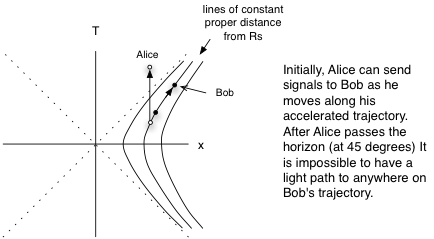
In the case of Minkowski space-time, Bob is simply constantly accelerating while Alice remains at the original location – in free fall. Eventually, there is no light path, one with proper time 0, from Alice to Bob. Bob can always send messages to Alice.
This same diagram also describes what happens near the horizon of a black hole. In order to hover at a given proper distance from the horizon, Bob must be undergoing constant acceleration, following one of the hyperbolic trajectories in the diagram. Alice is in free-fall, just as in Minkowski space-time. The same signaling restrictions also apply.
[One
comment from the audience (Michael Peeler) was that Bob can only see finitely
far into Alice’s future.
That is why Bob sees signals from Alice that show Alice slowing down
(the rate of a clock carried by Alice) as she approaches the horizon. Bob never observes Alice crossing
the horizon even though from Alice’s point of view nothing special happens as
she crosses it.]
Back to Black Hole Thermodynamics
In the last lecture we built a black hole with photons that carries one bit of information. Each bit added the same area to the horizon, indicating that the entropy of a black hole is proportional to its horizon area.
We are also interested in the temperature of a black hole.
 E
is energy, S is entropy
E
is energy, S is entropy
The change in energy is the energy of the photon we add.

We chose lambda to be
proportional to  so that
no location information was carried by the photon. This isn’t quite the right constant, but we are
looking for the form of the temperature.
so that
no location information was carried by the photon. This isn’t quite the right constant, but we are
looking for the form of the temperature.
So, for a change of 1 bit of entropy we add
 (dropped the 2)
What does this mean? Big black holes are cold. The temperature – energy relationship is backwards from our intuition. Normally, when we add energy, the temperature goes up. In this case it goes down.
With the right constants the expression is:
[Adding
correction here – forgot Boltzmann constant]

What is the temperature of a solar mass black hole?
Mass of the sun = 1.98892 x 1030 kg

Which is much colder than
empty space, which is filled with a  microwave background. Therefore, heat will flow from empty space to the
black hole, making it even colder.
microwave background. Therefore, heat will flow from empty space to the
black hole, making it even colder.
Suppose that the black hole was warmer than the surroundings, then heat flows out of the black hole, which makes it hotter! This increases the rate of heat flow and you have a runaway. A black hole in thermal equilibrium is unstable.
How fast do black holes evaporate? Let’s calculate luminosity in Plank units where h=c=G=1.
For reference:



The rate at which energy is lost by a black body in these units is
 Where
A is the area of the surface.
Where
A is the area of the surface.
But energy and mass are the same thing, so:

We can use our formula for
temperature  and
area
and
area
 [I added the 8pi]

We can solve this by integrating



So if at time 0, the black hole was gone, then at time –t it has mass M. This expression gives the negative of the evaporation time.
So how long does a solar
mass black hole take to evaporate [It wouldn’t really
evaporate until the universe expanded enough to cool the microwave background. For fun we can assume that empty
space is at 0 degrees.]



This is quite a long time.
Exercise: find the mass and size of a  black
hole.
black
hole.

so

Which is about half the mass of the earth.
Wrap Up
Standard General Relativity is like fluid dynamics. It misses the discreteness of energy and the microscopic structure and degrees of freedom of space. More is needed to explain the information stored on the horizon of a black hole.
Conservation of information is probably the most fundamental physical law of all.
An example: We associate translation invariance with momentum conservation. Suppose that when we slide an eraser across a table that it came to a stop because of the equations of motion instead of through frictional interaction with the tabletop. There is no problem with translational invariance, so what happened to momentum conservation? Notice that one could start the sliding with distinct initial conditions, but have precisely the same outcome. Information is lost. Conservation of momentum and energy depend on information conservation.
In classical physics information conservation is expressed in Liouville’s theorem, which requires that volume in phase space is conserved.
In quantum mechanics, the equivalent information conservation idea is expressed by unitarity.