Physics Notes: Cosmology
and Black Holes
Lecture by Professor Leonard Susskind
Lecture 4: Jan 31, 2011 Back to PHY33
Topics: Visualizing the metric around a black hole, the singularity, Penrose diagrams, Birkhoff’s theorem
Lecture Start
In previous lectures we investigated the geometry near the horizon. We learned that it is good old flat space-time.
We found this out by considering a new set of coordinates.
Instead of r [which corresponds to the area of the horizon
being a sphere of area  ],
we use
],
we use  ,
which represents the proper distance from the horizon.
,
which represents the proper distance from the horizon.
Q: What is proper distance?
A: Proper time is “wristwatch” time, where the wristwatch is carried along a space-time path. [Proper time is a scalar, which means that all observers will see the clock as having the same values at the end of the path – the “events”. ] Proper distance is what you get when an observer traversing the path marks off distance with a meter sticks. [Again, all observers would see the same number of meter sticks, regardless of velocity or acceleration.]
Along with  ,
we also substitute a new variable
,
we also substitute a new variable  ,
which replaces the time variable.
,
which replaces the time variable.
Proper distance with the new coordinates becomes
 We ignore the angular position
This is very similar to polar coordinates. These coordinates are hyperbolic
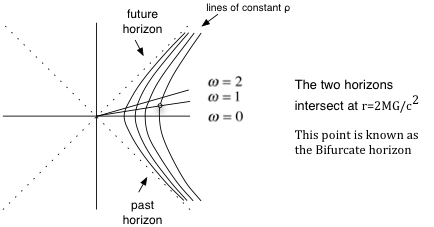
Far from the black hole the metric

Reduces to

Also, as  ,
so the metric in
,
so the metric in  terms is very similar It changes from

up close, to

when far away. The polar coordinate analogy is a bit easier to visualize…

A very similar thing happens in the correct hyperbolic geometry.
Close to the horizon,  slows time down, far away,
  becomes
decoupled from t.
becomes
decoupled from t.
The Singularity
Let’s review the story of Alice and Bob near the horizon. Bob is maintaining his distance from the horizon by constantly accelerating, and Alice lets go. Alice can signal Bob with her flashlight as she falls toward the horizon.

Bob sees a finite number of flashes from Alice at ever increasing separations. The flashes of light are red shifted. Alice freezes on the horizon.
Now suppose that Bob is signaling Alice. From Alice’s point of view, she continues to receive signals even after she crosses the horizon.

Alice would see the signals
from Bob as red shifted because Bob is accelerating away from her. [I think this confused people in the class because they have
heard of the gravitational red shift, which occurs when light moves between an
emitter and a receiver above it in a gravitational field or when both emitter
and receiver are accelerated.
In the accelerated case, during the time the light takes to propagate to
the receiver, the receiver undergoes a change in velocity. The red shift is simply the
Doppler shift associated with that change in velocity. The gravitational field must
yield the same result. Light
sent in the other direction will be blue shifted. The situation in the diagram above is different
because Alice is in free fall and Bob is being accelerated. The acceleration difference
produces the red shift for Alice.]
Q: If photons can’t escape from the black hole, then it seems like gravitons can’t either. How is it that a black hole has gravity?
A: The gravitational field is mediated by a cloud of virtual gravitons. They have no problem exceeding the speed of light. Changes in the field do propagate at the speed of light. If I (Professor Susskind) move to the right, then my gravitational field at your position changes after a time delay equal to the distance divided by the speed of light.
Another question – what happens to Alice’s feed when she falls feet first through the horizon of a black hole?
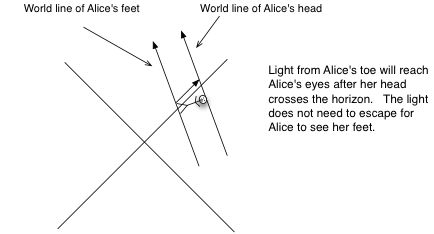
There is no time where Alice can’t see her feet. Suppose that at the last minute we grab Alice (the part outside) and save her. Bad things happen. Alice’s feet can’t be accelerated enough to escape. She would be de-feeted.
Now lets look at what
happens after Alice crosses the horizon. The center point corresponds to the horizon
where  . The metric is

Time contributes negatively and r contributes positively. After crossing the horizon, we see that the signs flip. Now r looks like the time variable. We haven’t drawn what happens in the region behind the horizon yet, and you might think the singularity at r=0 is a point, but in fact it is a hyperbola like the lines Bob follows in previous diagrams.

[I’m
not quite following the thought that the singularity is a hyperbola in
Schwarzschild coordinates.
I think this diagram is known as a Kruskal-Szekeres spacetime diagram
with slightly different coordinates. ]
No matter which way or how hard Alice accelerates, she will soon meet the singularity.
The laws of physics work under time reversal. The white hole singularity in the past could form an “Alice” and eject her through the past horizon. It is just very unlikely. Suppose a bomb exploded and scatter bits all over the place. We would be very surprised if junk flew back together to form a bomb. For one thing, the backward trajectory, while possible under the laws of physics, is very unlikely and unstable. A tiny disturbance would quickly grow to spoil the re-assembly.
Penrose Diagrams
We can diagram flat space using time and distance from the origin for our coordinates.

One problem with this diagram is that we can only show a small patch of spacetime.
What relativists do is to make a coordinate transform and squish all of spacetime onto the blackboard.
Rule 1: Squash infinite spacetime coordinates onto the blackboard
Rule 2: Light rays remain at 45 degrees (this is only true for radial rays).
The simplest Penrose diagram looks like:

Light comes in from the bottom right slanted line and goes out to the upper right slanted line. The curved light ray is curved because it misses the origin and has a closest approach of 1 unit of distance.
Now we can draw a more complicated diagram for a black hole.

The geometry contains another “universe” on the left side of the diagram, but there is no way to reach it. [I supposed objects or “people” from the left and right side could meet temporarily in the middle. ]
This diagram is for a static black hole. The real story has to do with the way the black hole was made. The most likely way to make a black hole is from a collapsing black hole. [We need to be able to describe a past with no black hole transforming into a space with a black hole.]
Birkhoff’s Theorem
Birkoff’s theorem is the general relativity version of the Newtonian idea that a spherically symmetric mass can be treated as a point mass at the center of mass position.
In the Newtonian version,
you can model  forces
using the idea of lines of force that emanate from masses (sinks for the field). The number of lines of
force coming from a mass is proportional to the mass. They simply go out to infinity. To compute the field in a
direction at a point, one measures the number of lines of force passing through
a small area orthogonal to the direction. If there are multiple sinks you can
just add the fields resulting from them.
forces
using the idea of lines of force that emanate from masses (sinks for the field). The number of lines of
force coming from a mass is proportional to the mass. They simply go out to infinity. To compute the field in a
direction at a point, one measures the number of lines of force passing through
a small area orthogonal to the direction. If there are multiple sinks you can
just add the fields resulting from them.
One conclusion is that if you have a spherically symmetric shell of mass, then on any containing centered spherical area you have the same number of field lines. For a sphere inside the mass shell, you have no field lines.
The general relativity
version says that outside the spherically symmetric mass shell that the
Schwarzschild metric is correct and that inside the shell the Minkowski metric
is correct. This is true even
if the shell is expanding and contracting. [I think the usual term for this is
“stationary”.]
We will use Birkhoff’s theorem to patch ordinary pre black hole space to a Penrose black hole diagram.