Physics Notes: Cosmology
and Black Holes
Lecture by Professor Leonard Susskind
Lecture 5: Feb 7, 2011 Back to PHY33
Topics: Building a black hole and Penrose diagram for the process, the temperature near the horizon
Q: how does the 45 degree light path work in Penrose diagrams
A: There is a theorem that says that there is a coordinate system transform that preserves the 45 degree angles. The theorem itself not too important for our use of Penrose diagrams.
Q: What
is the complete metric using  and
and  , especially away from the horizon.
A: This is
worth an exercise. First, we
can relate them to t and r.  is
simple, it is simply the scaled proper time:
is
simple, it is simply the scaled proper time:
 where
where 
 is the
proper distance from the horizon.
is the
proper distance from the horizon.

Imagine moving on a surface of constant time from the
horizon, then  and
and  are the
same thing.
are the
same thing.

We can figure out the relationship between  and r by
integrating.
and r by
integrating.

[For fun I used Mathematica to
integrate this. It isn’t
pretty.

We can check the extremes. For r=0 the equation is obviously
correct. For  , the second term goes to a constant and the third
term grows logarithmically, which is much slower than the first term, so the
first term will dominate and the function will grow linearly with r.
, the second term goes to a constant and the third
term grows logarithmically, which is much slower than the first term, so the
first term will dominate and the function will grow linearly with r.
]
The inverse  will be
even messier, but it is a function that can be evaluated.
will be
even messier, but it is a function that can be evaluated.
We can substitute this inverse function back into the Schwarzschild metric.


The scaling for  is near 0 at the
horizon and at infinity goes to the constant
is near 0 at the
horizon and at infinity goes to the constant

Lecture Start
How do we build a black hole? Last lecture we had a Penrose diagram for flat space and another Penrose diagram for a black hole. [Making a black hole would be a time evolution from flat space to a black hole diagram.]
Last lecture we covered Birkhoff’s theorem, which says that inside a symmetrically distributed shell of mass/energy, that the metric is flat, and that outside it is the Schwarzschild metric. This is true even if the shell is expanding or contracting. Suppose we placed a continuous array of lasers on the surface of a large sphere. We point all the lasers towards the central point and use them to generate a brief but intense inwardly directed pulse of light. This light is symmetrically distributed and carries energy or equivalently mass. It satisfies the conditions for Birkhoff’s theorem. As time goes by, the shell shrinks and eventually has a smaller surface than a black hole with the same mass.
Let’s draw the Penrose diagram for this. We start with the flat space diagram.

The fix for the incorrect metric to the upper right of the light world line is to paste in the part of the black hole diagram corresponding to that region.
For reference, the black hole diagram was:

Pasting these two diagrams together, we have
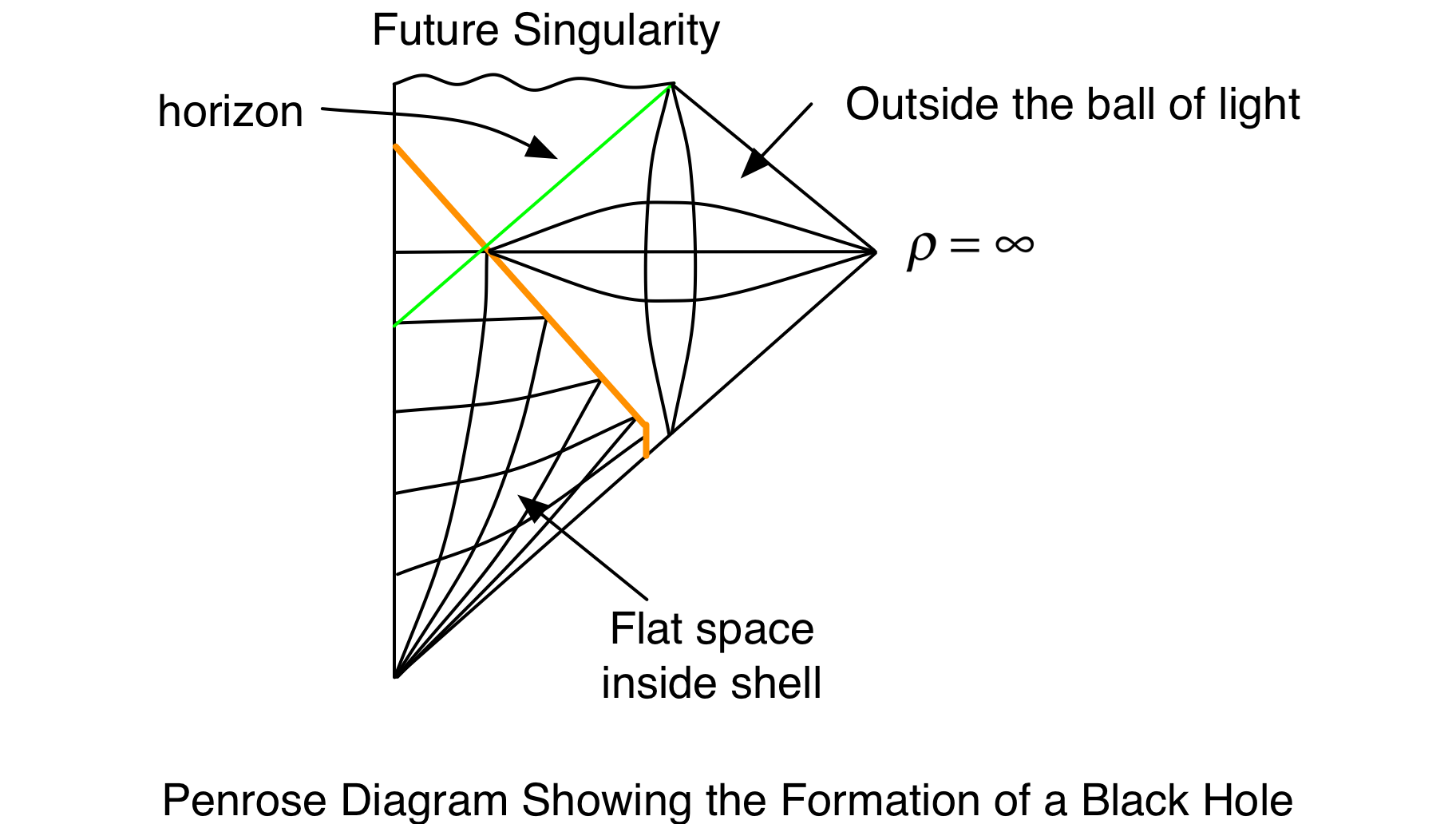
The bend in the orange line slanting up to the left in the diagram is the time that the lasers were fired. Before that, I assumed that the energy was stored at the location of the lasers. The stored energy was at a fixed distance from the center.
Note that the small region that is inside the horizon, but to the left of the incoming shell of light. This is still flat space, even through it is inside the horizon. Imagine that our friend Bob has been sitting at the center of the laser ball since before it was fired. He notices nothing as the horizon forms around him. On the other hand, an observer in the upper right of the diagram, outside of the horizon will see Bob accrete on to the horizon. [It seems like the horizon will start out as a tiny surface and expand, picking Bob up as it enlarges to its 2MG “radius”.] The principle here is that all the mass of a black hole is on its surface when observed from outside.
Revisiting the Temperature of a Black Hole
In a previous lecture we determined the temperature of a black hole.

This temperature is the temperature as seen from a large
distance. We can ask the
question, what temperature would an observer at a proper distance from the
horizon see?
from the
horizon see?
Suppose we had a hot surface with molecules jumping off. Right at the surface, we would expect the distribution of kinetic energies to reflect the temperature of the surface. The expectation value of the kinetic energy is the temperature. This is their only mode and they are in thermal equilibrium with the surface. At a height above the surface the molecules lose some energy due to moving up in a gravitational field, so the temperature of the gas of particles drops.
The same thing happens with photons. We can compute the loss of temperature with height from a black hole due to the loss of energy of the photons as they climb away from the horizon. We won’t do the calculation here, but we will use the result.

[This must be an approximation
because it doesn’t match  as
as  .
It is probably accurate near the surface …]
.
It is probably accurate near the surface …]
Suppose you lower an atom to the surface. At some point the temperature rises high enough to ionize the atom. How does this make sense, the horizon is just a surface in space-time. If we drop the atom through, then from the point of view of the atom, nothing special happens. There is no temperature rise.
We have to be operational about the apparent contradiction. By operational, we mean that we have to design experiments to measure the temperature and report back to an observer outside of the horizon.
A fundamental limit on measurement is the uncertainty principle.

If we have measured the position of a particle with a given accuracy, then the particle does not even have a precise momentum. The same is true of energy and time (when something happens).
If we want to test if an atom has not been ionized, then we
can hit it with a photon and get a difference in behavior. So our experiment is to drop the
atom and to hit it with a photon below some proper distance  from the horizon. In this case, to image the atom we would need a photon
of wavelength
from the horizon. In this case, to image the atom we would need a photon
of wavelength  .
Such a photon has energy
.
Such a photon has energy
 in
natural units
in
natural units
But this is approximately equal to the estimated temperature at this proper distance. The measurement of the atom will change its energy by an amount on the order of the temperature.
The conclusion is that any experiment you do to show that the atom is not ionized will itself ionize it. The distance over which the temperature is high is very small.
There is no experiment you can do that confirms the safety of crossing the horizon.