Physics Notes: Cosmology
and Black Holes
Lecture by Professor Leonard Susskind
Lecture 6: Feb 15, 2011 Back to PHY33
Topics: The degrees of freedom on horizon, the entropy of a string vs. the entropy of a black hole
Q: Following up on the last lecture. Suppose we dropped a probe in free fall, connected to a cable, just long enough to reach a target height over the horizon. While falling, the probe records temperature readings. When it hits the end of the cable, we pull it back out. This way we can measure the temperature close to the horizon as seen by a free falling observer.
A:
Have to think about this one.
[Stopping the probe just short of the horizon is a huge
kinetic energy change, which would itself raise the temperature. You couldn’t tell exactly when the
temperature change happened either.
]
The next question appears to be the right leading question, so I will call this the start of the lecture.
Lecture Start
Q: Where does the kinetic energy come from that heats up the incoming particles?
A: It comes from quantum fluctuations. Suppose that you have a quantum harmonic oscillator.
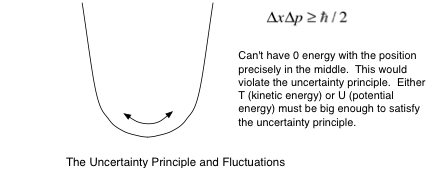
The same thing is true of virtual particles. If you look very carefully on small distance scales or short time scales you will see high-energy particles. The Feynman diagrams describing these particles are called vacuum diagrams. The simplest ones are simply loops.

In this case

Which says that as long as the time over which the loop exists is short, that the energy can be quite large.
Imagine that we are looking very closely at space near the black hole horizon.
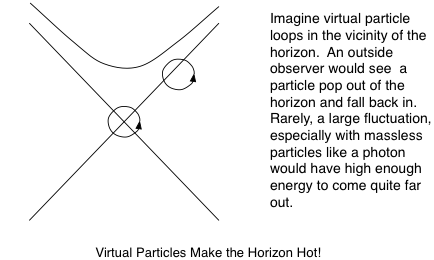
Temperature relates to the mass of the black hole in the following way. The observed temperature at a distance is based on the distribution of energies of particles emitted by the black hole as they reach that distance from the black hole. The larger the black hole, the more energy is lost escaping.
Proton Decay and Black Holes
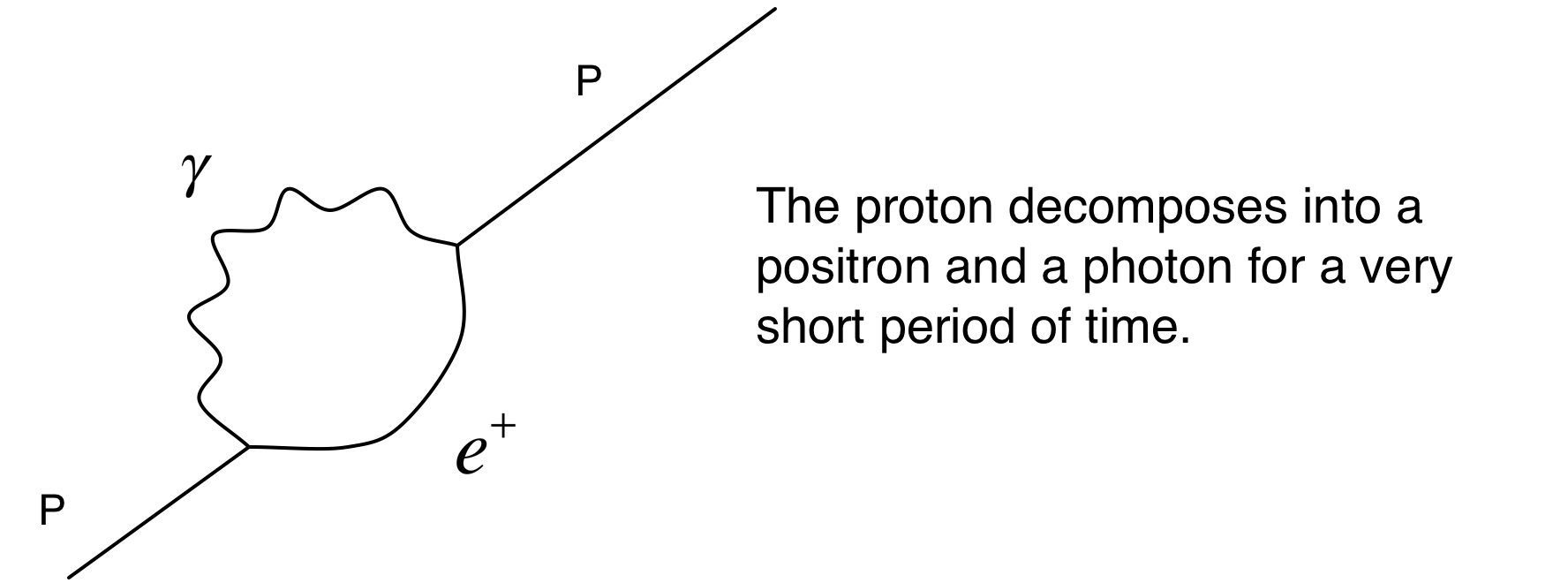
In all known viable theories of particles, the proton is not stable. Experimentally, the lifetime is very long. At least 1033 years. What could a proton decay into that would have less mass? We have to preserve charge, energy, momentum and angular momentum. One possibility is decay into a positron and a photon. Anything that can happen must be happening. Since we don’t see protons decaying, the positron and photon must be recombining. The Feynman diagram would look like
Now suppose this is happening to a proton falling into a black hole:
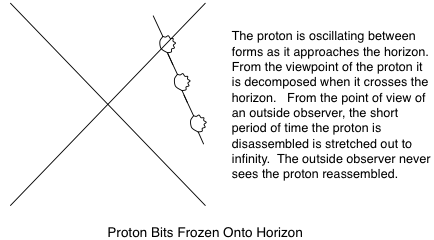
From the point of view of an outside observer, the horizon is a hot environment; hot enough to break up the proton. Just like the ionization of the atom we discussed previously, then only way to check if the proton in free fall decays is to use a high-energy photon, high enough to cause the proton decay. There is no way to know.
Q: Would we observe the same decay at the cosmic horizon?
A: Yet. It would be just like a black hole.
Q: What happens when entangled objects are split across the horizon?
First let’s describe entanglement. The classical version of entanglement can be demonstrated by having two different coins, say a nickel and a dime. I let you pick one and put it in your pocket without looking at it or in any way figuring out which one it is. Later I look at my coin, find that it is a nickel and immediately know that your coin must be the dime.
In quantum mechanics we can do this without either object being in a definite state. We can prepare two electrons so that we know that their spins are opposite, but without knowing the spin of either electron. This is an entangled state. The electrons can be separated and later the spin of one can be measured. If it is spin up, then the other one, wherever it might be, is now known to be spin down.
Entanglement is preserved even if one of the electrons interacted with another system. The entanglement information gets mixed into the state of the system the electron interacted with. In the case of a black hole, we could form an entangled pair of electrons and let one drop onto the horizon of the black hole. If the black hole is then allowed to evaporate, then all that came off was Hawking radiation. The information is mixed into the information of all of the radiation from the black hole.
What Carries Information in a Black Hole?
String theory gives a resolution to “what carries entropy on a black hole?” We need a large number of microscopic degrees of freedom.
General relativity is like fluid dynamics – no microscopic theory.
First we should ask what the natural unit of length for gravity is.
 The
Planck length
The
Planck length
In units where c=1 and 

Second, we want the natural unit of length for strings. Suppose we are given a string coupling constant g (which is the probability that a string breaks or joins). This has a similar role to e for electrons and photons. If two strings interact gravitationally, then they exchange a bit of string. A small closed loop is budded off of one string and caught by another. Both the budding off and the catching of the loop involve a factor of g that we have to include in the amplitude for this interaction. The general form looks something like

[I supposed the M’s are adding in
all the sites on each string that could bud off or absorb a loop. 1/r2 makes
intuitive sense too.]
But this looks very similar to the standard Newtonian formula for gravitational force. One problem is that G has units of length squared, while g is unitless. It is just a probability. To fix the units we can write

Then we determine  from g. We expect g to be between 0 and 1. If it is larger, then we don’t know how
to model string theory anyway.
from g. We expect g to be between 0 and 1. If it is larger, then we don’t know how
to model string theory anyway.
We can now relate  to
to
 :
:

Now we need to talk about entropy. We previous determined that the entropy of a black
hole was its area measured in units of G.
BTW – we are using ultra natural units where  and
and  as well. We don’t care about small
constant factors.
as well. We don’t care about small
constant factors.

Now lets figure out the entropy of a string. If you pump a string – add lots of energy to it – then you get a big tangle. Most big tangles are hard to tell apart, which fits the idea of having lots of indistinguishable configurations. We can use a simple lattice model to estimate the number of configurations. Despite its imperfections, it gets the right answer.
In an m-dimensional lattice each point has 2m nearest neighbors. Imagine that you place the string end at a point. Then you can lay the string out, going from neighbor to neighbor across a link. At each point you have 2m choices. It is allowed to retrace your path.
[For now I will just assume that we are working on the 2d
horizon.
I’ve decided to include the starting
position of the string, not clear if that makes a real difference yet. I’m also modeling an open string with
ends. One question during the
lecture was – if you have the same total length of string, are there more
states for 1 string or for many strings]
Let the spacing between neighbors be  . Then the number of links between
neighbors that we can cover is
. Then the number of links between
neighbors that we can cover is

It is also the case that the mass of the string is simply n times the mass per link. In our units, the link mass is simply

And the mass of the whole string, which is also the mass of the black hole, is

And the number of ways to lay down the string is


The first part is the number of shapes and the second part is the number of starting positions. Imagine that the lattice covers the horizon of the black hole. Then the number of lattice positions available for starting points would be the area of the horizon divided by the area of a cell in the lattice.
We take the log to get the entropy of the single string.

[If you had two strings of length  , which yields the same total mass, then you would have


This is not matching up with the
assertion in class that the single string has more configurations. I must be missing something

For large n, the first term obviously
dominates, so it looks like two half-length strings have more states than one full-length
string. Perhaps if the
number of pieces is something like  . Then
as k gets closer to 1, then the ignored constant terms get a factor of n in
front and add up to a big enough value. On the other hand, one also gets a large number of
ways to split up the long string if you allow different length strings. I’ll have to wait for
the next lecture.
. Then
as k gets closer to 1, then the ignored constant terms get a factor of n in
front and add up to a big enough value. On the other hand, one also gets a large number of
ways to split up the long string if you allow different length strings. I’ll have to wait for
the next lecture.
]
For large n the string entropy is simply linear in n.

This is not quite working. The string entropy is proportional to the mass of the single string, but the black hole entropy is proportional to the mass squared.
[Something like time dilation is
probably going to save us]
In string theory, the value of g is not a constant. It can be changed. Suppose we start with a value close to 0. In this case a massive string could be star sized.
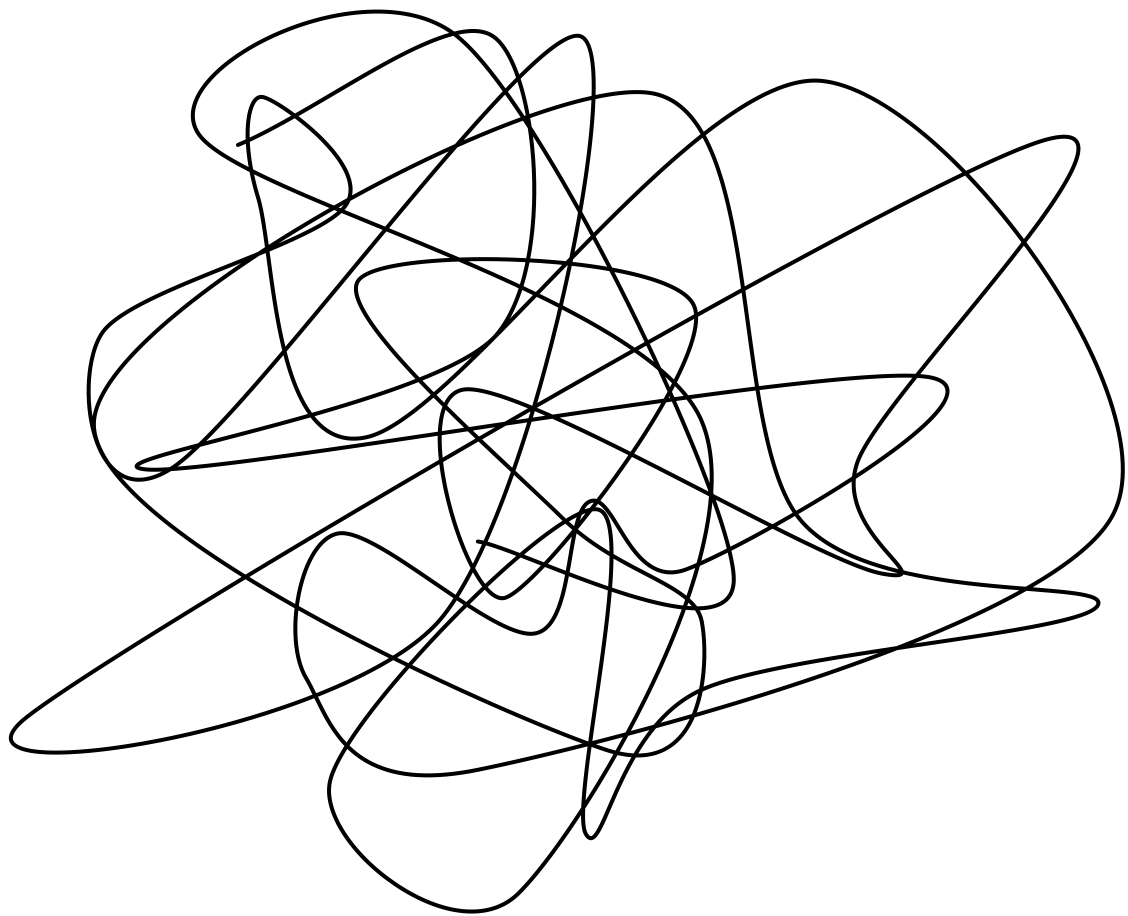
This can’t be a black hole since g is close to 0. If g gets bigger, then  gets bigger,
which means that G is bigger.
However, the energy of the string will decrease because L is less. It will be denser. Eventually you get a black hole. The string is distributed
on the horizon.
gets bigger,
which means that G is bigger.
However, the energy of the string will decrease because L is less. It will be denser. Eventually you get a black hole. The string is distributed
on the horizon.
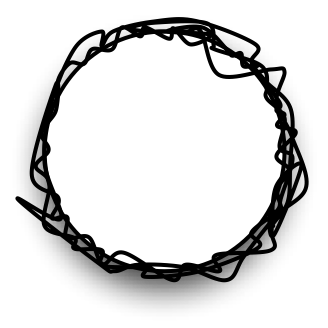
This change of g can be done very slowly, yielding an adiabatic change. When a control parameter is changed very slowly, information is conserved and entropy does not change.
An important transition point is the where the string
becomes a black hole.
This transition point comes where the radius of the black hole is the
same as the size of the wiggles in the string, about  .
.
 Schwarzschild
radius equals string length scale
Schwarzschild
radius equals string length scale


For next time – An adiabatic change does not change S because of conservation of information. A slow change of g qualifies.
Start with a black hole of mass  at
at  .
Now reduce
.
Now reduce  slowly. The
black hole turns into a string (a single string most likely). Now measure S. This must have been the entropy
of the black hole.
slowly. The
black hole turns into a string (a single string most likely). Now measure S. This must have been the entropy
of the black hole.
If all goes well, the formulas will end up matching.
An article that covers related material:
http://193.51.104.7/~damour/publications/P99-94.pdf