Physics Notes: Cosmology
and Black Holes
Lecture by Professor Leonard Susskind
Lecture 7: Feb 28, 2011 Back to PHY33
Topics: String Configurations, Resolving String Entropy with Black Hole Entropy, an Expanding Universe has Horizons, De Sitter Space
Q: There was an open question last time about the number of configurations of a single string vs. a collection of strings of the same total length. Can we revisit that?
A: The configuration of a string can be thought of a random
walk on a lattice.
If the length of the string is  ,
where
,
where  is
the scale of the minimum sized wiggle in the string, then the number of bits needed to describe the configuration
is proportional to the number of directional decisions along the string, or n. For a 2d world, two bits are
required at each decision point to pick between left/right/up/down. Higher dimensional worlds require
more bits per decision point, but the number of bits remains proportional to
the length.
is
the scale of the minimum sized wiggle in the string, then the number of bits needed to describe the configuration
is proportional to the number of directional decisions along the string, or n. For a 2d world, two bits are
required at each decision point to pick between left/right/up/down. Higher dimensional worlds require
more bits per decision point, but the number of bits remains proportional to
the length.

Lets start with a single string confined in a box.
Now imagine breaking up the long string into many pieces at the marked
cut lines and bring the ends together. The smaller strings will remain in the box.

The high frequency wiggles remain, but the low frequency wiggles from
the original string are lost.
The more pieces, the more low frequency information is lost. Despite the additional
position freedom of the individual strings, this loss of the low frequency
configuration information means that chances are overwhelmingly likely that you
have a single string.
[This still isn’t satisfying. We still need to argue that the
long wavelength configuration information we lose is more than the extra
position information added when we break the string up. It would be best if they were of
different order.]
Lecture Start
Let’s return to resolving the string entropy with the black hole entropy.
Reminders from previous lectures
We set  . G we will leave alone because we
will be changing it during the analysis.
. G we will leave alone because we
will be changing it during the analysis.
Given this assignment of units, we also have

Aside: The easy way to figure this out is to pick some standard equations involving the quantities and use them to connect the units. For example we can use the mass relationship to energy and the energy of a photon.

Given our assignment of  ,
this immediately leads to
,
this immediately leads to

We can get the units of G (Newton’s constant) in a similar way.
 Relates
acceleration to mass and distance
Relates
acceleration to mass and distance

Setting c=1 means that length and time have the same units, and we know how to convert mass to 1/length. This gives us

So G is in units of area.
 In
fact, G is the Planck length squared.
In
fact, G is the Planck length squared.
Last lecture we determined the relationship between the string coupling constant g, the natural string unit length and the Planck length.

The string entropy was proportional to its length.

We also had the entropy for a black hole of mass M, which was proportional to the area of the horizon.

These two values for the entropy of what should be the same object are quite different. One is first order and the other second order in the mass.
We are missing something important. What we are missing is the gravitational effect of the string on itself.
A feature of string theory
is that the coupling constant g is not a really a constant. It can vary or be varied. If we hold  constant and vary g, then we are changing G,
which is why we didn’t want to set it to 1 along with c and
constant and vary g, then we are changing G,
which is why we didn’t want to set it to 1 along with c and  .
.
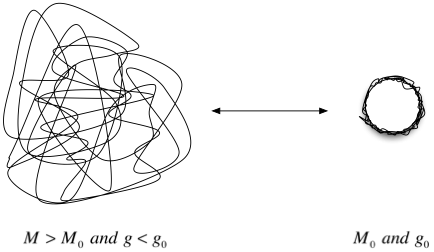
If we start with  ,
then strings don’t interact and gravity is “off”. A large string would expand into a large ball. Now if we increase g,
then the ball of string will shrink, eventually becoming a black hole. Now run it in reverse, the BH has
to turn into a single string [Within a bounded volume, this is the most probable subset of
string states. However, I
note that the classroom appears to be made of many small strings. Why is that? It also seems that as g is slowly decreased, that Hawking
radiation would carry away bits of string, so it seems unlikely that we recover
a single large string. Perhaps
the bounded box requirement has something to do with it. In an unbounded box there is a
lot of position information. I suppose that gravity might
effectively confine most of the string to a “box”. Something to
think about.]
,
then strings don’t interact and gravity is “off”. A large string would expand into a large ball. Now if we increase g,
then the ball of string will shrink, eventually becoming a black hole. Now run it in reverse, the BH has
to turn into a single string [Within a bounded volume, this is the most probable subset of
string states. However, I
note that the classroom appears to be made of many small strings. Why is that? It also seems that as g is slowly decreased, that Hawking
radiation would carry away bits of string, so it seems unlikely that we recover
a single large string. Perhaps
the bounded box requirement has something to do with it. In an unbounded box there is a
lot of position information. I suppose that gravity might
effectively confine most of the string to a “box”. Something to
think about.]
Another important concept is that a slow change in a control parameter does not change entropy. The strength of an external magnetic field, or the value of the string coupling amplitude both qualify as control parameters.
Entropy is unit-less, so that tells us that if entropy is a function of the mass, then we have to combine it with a constant that has inverse units. This tells us that entropy has the form:

This doesn’t tell us the form of F. It could be linear, squared, cubed or something stranger. That is still to be determined.
We can reexpress  ,
yielding
,
yielding

Since we are going to change g adiabatically, which doesn’t affect S, we know that

so ignoring the constant in the spirit of the
rest of the argument

Our strategy is to lower g until we know we have a string. Then we can use the mass associated with that value of g to compute the entropy. This must be the entropy of the BH from which the string came, since the change of g was Adiabatic.
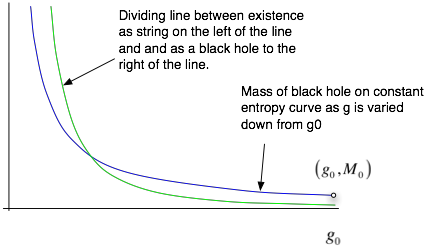
To make this work, we need to known when a black hole turns into a string. As g decreases, G decreases and therefore the radius (2MG) of the black hole also decreases. When the radius drops under the minimum wiggle size of a string, then we will declare the object a string and not a black hole.

so

In the graph below the green line divides the space where an object of a given mass is a string from the space where it is a black hole. The blue line is a mass vs g curve for a particular black hole mass M0 at coupling amplitude g0. When it crosses the green line, we have a string.
[My notes are fuzzy about the path to the result. I’m just going to figure it out myself. This may not be the same as Prof Susskind’s path. ]
The black hole mass curve gives us g as a function of M:

We can use this to eliminate g from the equation for the string/black hole dividing line curve:

or

Multiplying on both sides
by  and using the fact that

At this setting of g, we have a string and we can recognize the left hand side as the formula for the entropy of a string. We also recognize the final expression on the right as the area (up to a constant) of the black hole, which is the black hole entropy expression.
So the string entropy is consistent with black hole entropy.
Notice that the calculation
did not give an  answer
that would have corresponded to the volume. We will come to this in the next section.
answer
that would have corresponded to the volume. We will come to this in the next section.
This analysis also points out that general relativity misses the microscopic structure of at the horizon; much in the way fluid dynamics ignores molecules.
The Holographic Principle
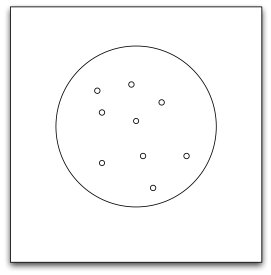
We start with a question – What is the maximum entropy a system can have? Suppose we take a volume and divide it into a lattice of small cells. We will assume that we have one type of atom and that each cell is sized so it can either have one or zero atoms. There are many possible configurations.

The maximum entropy is then the log of this quantity, or
 Using the
natural base for the log
Using the
natural base for the log
 This is proportional to the volume and also implies
a number of degrees of freedom that scales with the volume.
This is proportional to the volume and also implies
a number of degrees of freedom that scales with the volume.
Imagine a spherical region
of space populated with stuff.
We require that the mass M be less than the mass of a black hole of the
same radius.
The number of degrees of freedom appears to be related to the volume of the sphere.
Now at a distance we surround the sphere with a shell of mass, which if we added it to the sphere, would form a black hole. We could do this as before with an inwardly directed spherically symmetric pulse of light.
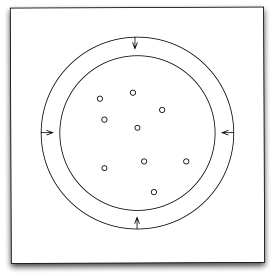
When the shell of mass reaches our original sphere, the mass is now equal to the required mass for a black hole of the spheres radius. The entropy of the black hole is now a known quantify related to the area of the horizon.