Physics Notes: Cosmology
and Black Holes
Lecture by Professor Leonard Susskind
Lecture 8: March 7, 2011 Back to PHY33
Topics: The Expanding Universe and Energy Density Scaling, Horizons in de Sitter Space
Q: I came in during a question about virtual particles
A: Virtual
particles are like the quantum harmonic oscillator. A classical oscillator has a ground state right at the
bottom of the well, at position 0 with no velocity. With quantum mechanics, you can’t have a precise location
and no velocity due to the uncertainty principle. There are always some fluctuations. This leads to a ground state
energy of  . [In a sense, QFT describes an
infinite set – a field - of harmonic oscillators.]
. [In a sense, QFT describes an
infinite set – a field - of harmonic oscillators.]
Q: Wouldn’t the vacuum energy associated with virtual particles affect the speed of light? [This is actually a great question! ]
A: Is the world translation invariant? It is obviously not true. For example, Stanford != Berkeley. When we talk about translation invariance, we don’t mean that the configuration is the same. So
Is the world Lorenz invariant? No
Are the equations of physics Lorenz invariant? Yes!
Stuff in the world breaks symmetries. Light moving through space has a different velocity in different materials.
Vacuum energy is special. It is inherently Lorenz invariant [by construction of the QFT]. We can detect it and measure it. Then if we whiz by at high speed we can measure it again. We get the same value! If the only energy in a region of space is vacuum energy, then light will move at c.
Fragment:
The idea of moving at the speed of light is a local concept only.
Lecture Start
We will start by describing a universe uniformly filled with energy of various types.
First, suppose that the universe if filled with ordinary particles like protons. By filled we mean with a certain density.

m is the mass of the proton, n is the number of particles in a box, and V is the volume of the box.
[Aside: The current energy density of the universe is 9.9x10⁻³⁰
g/cm3. It is believed
that 4.6% of that is made of atoms and 23% is dark matter, both of which
qualify as “ordinary” particles for our purpose.
]
Imagine that the universe expands, increasing by a factor of 2 in each dimension, then

As the universe expands,  dilutes. This is not true of vacuum energy. Vacuum energy is a property of space. The more space you have the more
energy you have.
dilutes. This is not true of vacuum energy. Vacuum energy is a property of space. The more space you have the more
energy you have.

Why do we care? In almost all physics, energy differences are what matter. In general relativity the absolute value of energy matters. So vacuum energy gravitates. Vacuum energy is a feature of quantum field theory. It is associated with the minimum wiggles in the fields.
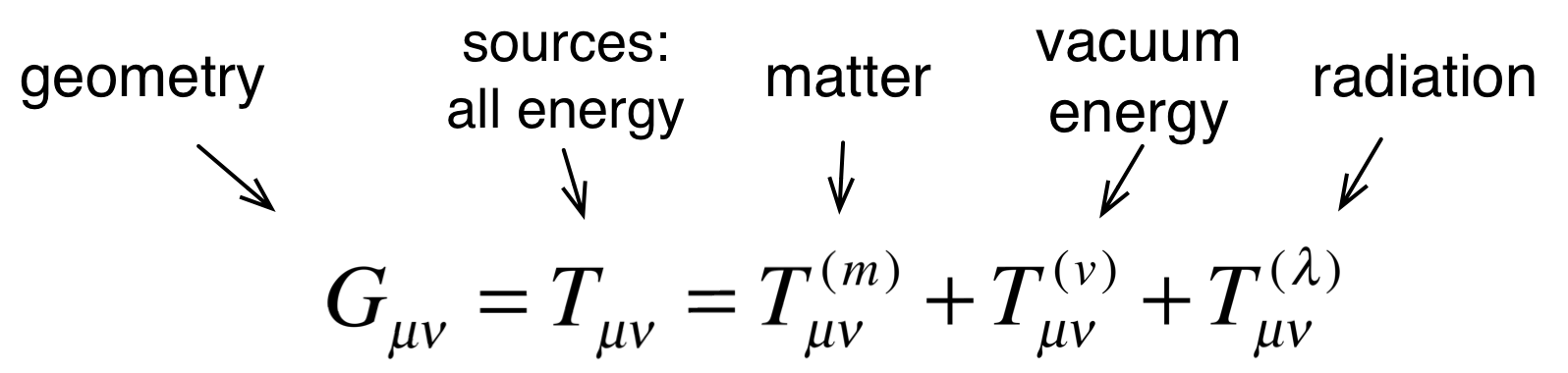
A difference is how the different contributors to energy change as the universe scales. Radiation drops faster than ordinary matter because the scaling of the universe also increases the wavelengths of the photons, decreasing their energy.
Let’s example the simplest non-static geometry. The metric we will use is

In this expression  stands in for all three directions of space.
This space-time geometry
has curvature. For a
universe with a uniform(in space) energy density  ,
the geometry/energy equation reduces to:
,
the geometry/energy equation reduces to:
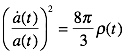
A confusing point is about conservation of energy. On the right of the above equation is the energy of the contents of the universe. We can rewrite the equation slightly as:
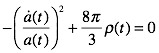
The first term is negative [in an expanding universe] and exactly cancels the ordinary energy in the universe. We identify this negative energy as a kind of kinetic energy associated with the change in the geometry of space. Energy is conserved and in fact is always 0.
We can solve the equation for the various types of energy. The solutions for vacuum energy, ordinary matter, and radiation energy are different because they vary differently with the expansion of space.
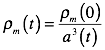 Matter density decreases inversely with
volume
Matter density decreases inversely with
volume
 The density of vacuum energy
does not change
The density of vacuum energy
does not change
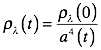 Wavelength increase drops radiation
density faster
Wavelength increase drops radiation
density faster
We can solve the equation for ordinary matter first.
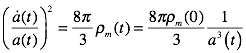
Multiply through by a3(t):
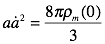
Take the square root and multiply through by dt:
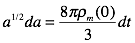
Integrate:
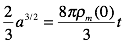
Solve for a
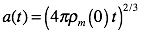
If we plot the curve a(t)=t2/3 we can see that the expansion of the universe is slowly decelerating.
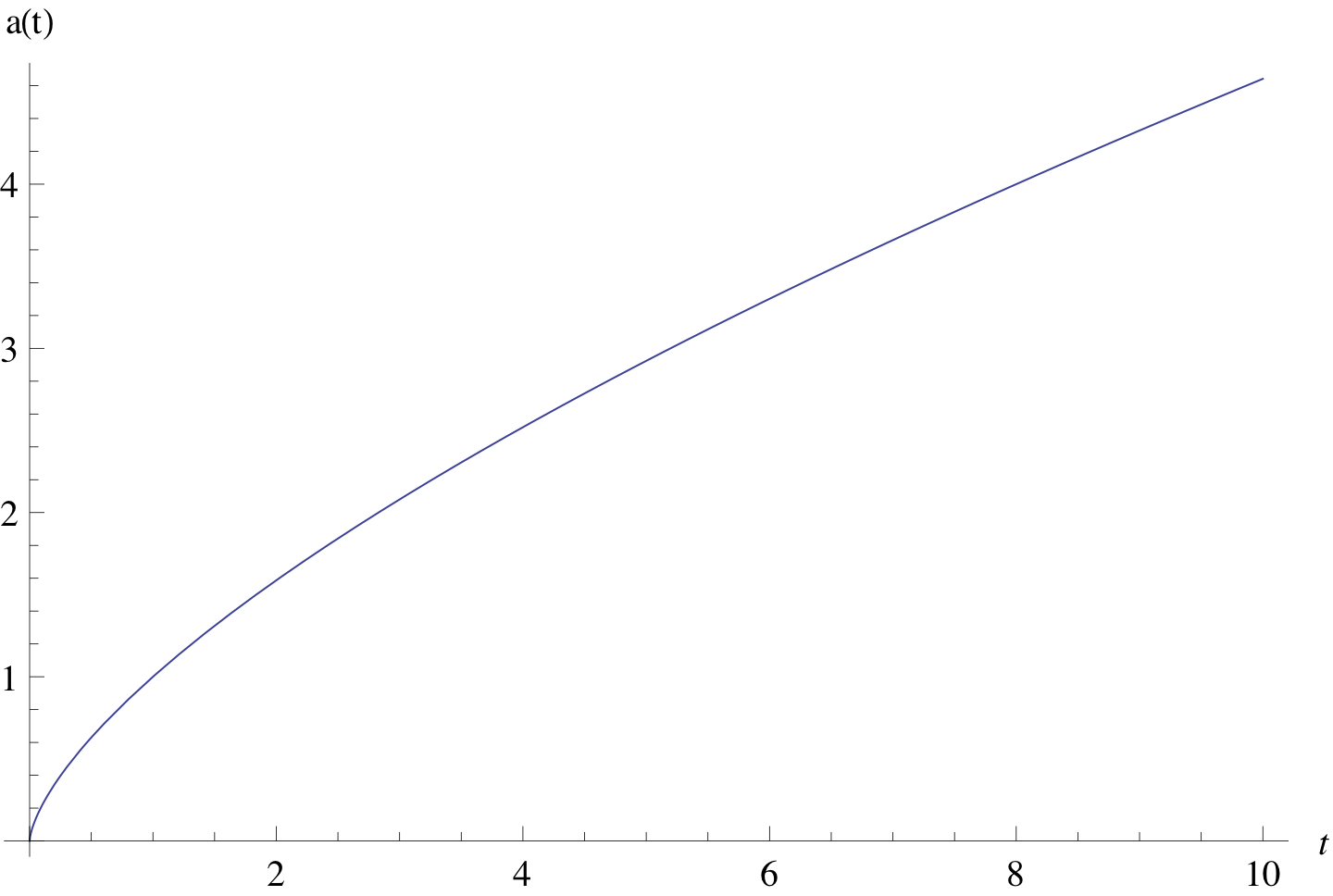
What does this mean? Thinking in terms of gravity we would say that gravity is pulling stuff together.
What happens if vacuum energy is dominant?
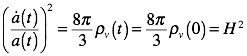
We will let H2 be the constant on the right. We can take the square root to find:

Which has a simple solution:
 Where A is a constant of integration.
Vacuum energy leads to an
exponentially growing universe. We could measure this by checking the Hubble
constant over time to see if it is constant. We could also set up a lab in empty space
with two very light objects placed at a known initial displacement and
wait. The expansion of the
universe will move them apart at a velocity proportional to their distance from
each other. [I have a small problem with this experiment. How do I place them at rest at a
specific x distance from each other?
I imagine connecting them with a rod of a known length and then
releasing the objects carefully.
Doesn’t this process
give the objects a dx/dt (not
ds/dt which will be 0) “velocity”
towards each other that compensates for the increasing a(t)? Need to do a bit more analysis
here.]
In Astronomy, we can look back in time with telescopes and measure H at different times. It is not historically constant, but appears to be approaching a constant.
In the real world, radiation, ordinary matter, and vacuum energy contribute to energy density. The equation is a bit more complex, but eventually vacuum energy dominates. We are currently at over 70% vacuum energy.
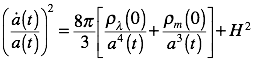
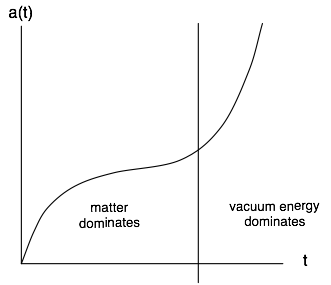
Our conclusion from observation is that vacuum energy is not 0.
This model also says that if we wait some billions of years, then all but the closest bound galaxies will spread away from us until their relative velocity exceeds c and we are cut off from them. We can imagine that an astronomer in a civilization of that time would come to the conclusion that they live in a very special place, a conclusion at odds with our current view. Space outside of the local cluster of galaxies would be empty.
Horizons in an Expanding Universe
We can substitute the vacuum energy based solution back into the metric, yielding:

This metric describes what is known as de Sitter space(-time). As we will see, it is even weirder than it looks.
Let’s remind ourselves about observing the horizon of a black hole. There will be similarities.
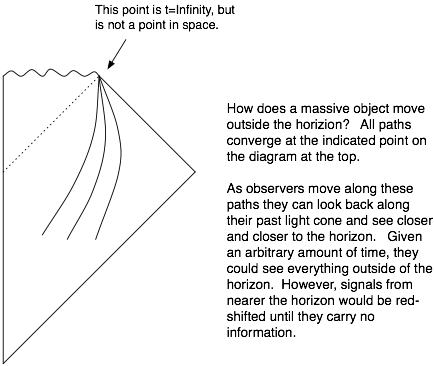
Now we would like to draw a similarly useful diagram for de Sitter space. One objective is to get all of future time onto the diagram. Another is to preserve light paths as being 45 degree from the vertical. To do this we will introduce a new coordinate T.

We can integrate this to yield

Note that as  , T does also. What happens as
  ?
In this case
?
In this case  .
So all future time ends at 0.
.
So all future time ends at 0.
Substituting into the metric we have:

The variable substitution was cleverly selected to make the scaling for dT and dx the same. Factoring the common term out we have:

This is key, because light paths require that this quantity be 0. The only way to make that happen is to have

Which confirms that light will move on 45 degree paths in our diagram.
We can rewrite the metric to eliminate t.
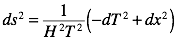
Aside from the scale factor out front this metric looks like Minkowski space-time.
Let’s draw a space-time diagram with Alice and Bob as observers at a fixed x displacement from each other.
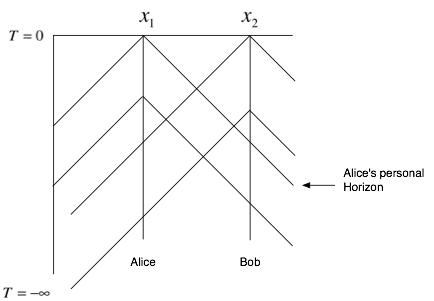
Alice and Bob are at constant x, but their proper distance is increasing as T goes to 0. At T=0, Alice can only see part of Bob’s path. From her point of view as she approaches T=0, Bob is approaching Alice’s personal horizon. Like a black hole horizon, messages from Bob will be more and more red-shifted, and time appears to slow down for Bob. The reverse is also true. No matter where you go, you are on a horizon for some observer.
Alice and Bob could be galaxies. Eventually all other galaxies that aren’t bound to Alice will end up on Alice’s horizon and the universe will seem quite empty.