Physics Notes: String
Theory
Lecture 11: Jan 10, 2011 Back to PHY32
Topics: String Theory Wrapup, S[trength]-Duality between D1-branes and strings
Note: This lecture is intended to wrap up the String Theory quarter. It happened to be given in the following quarter. Prof Susskind says that the first quarter of 2011 will focus on black holes and cosmology.
Books
An audience member brought up “The Little Book of String Theory”, Prof Susskind agreed that it was ok but less technical.
He then suggested the book by Barton Zwiebach
A First Course in String Theory
When searching for the book I discovered that Barton Zwiebach has a 3 video lecture series on string theory.
Q: what are the constants in string theory.
A: There are no constants in string theory. There was some review of the meaning of fundamental constants á la lecture 6. [I suppose that there are observable constants like the local ratio of D1-string mass/unit length vs Fundmental string mass/unit length. I think the argument is that these ratios are fields that could be different in different regions and therefore not constants in the theory. Prof Susskind did make the comment that these fields can only make discrete steps, which sounds to me like domain walls.]
As an example we can look at the ratios of dimension size in a 2-d torus
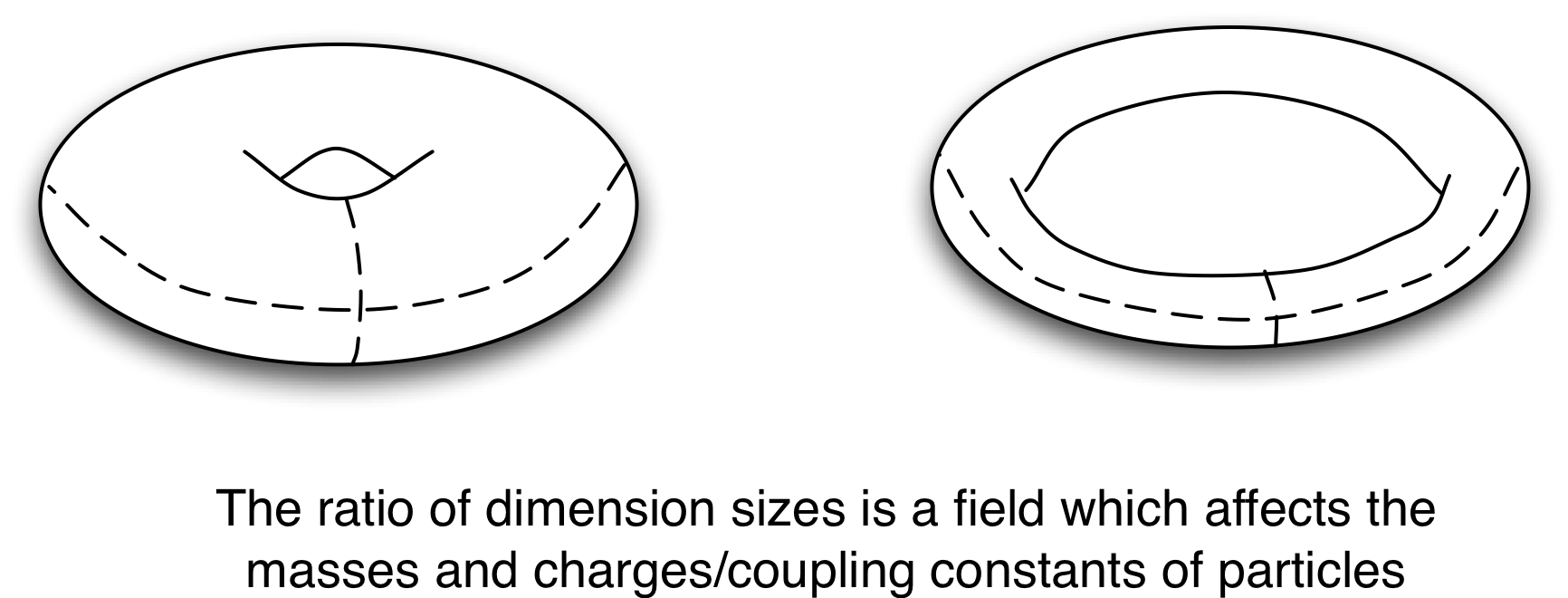
Why are the ratios in string theory fixed? Not known. [Key
constants like the fine structure constant are known to have the same value in
studies of the early universe as they have today.]
Lecture
We start with the philosophy of reductionism.
Big things are made of smaller things – recursively
A house is made of bricks, which is made of molecules, which is made of atoms …
Another aspect of reductionism is that the house is complex, bricks are simpler, and atoms are simpler yet. There is value in studying the properties of houses and bricks because there are emergent properties of complex systems that are not obvious from the smaller/simpler levels. [I am in the middle of “The Cosmic Landscape” and may be mixing in a bit from there – not sure].
So why isn’t particle physics simple yet? There are some 75 particles in the standard model, with perhaps 20 truly distinct ones [I assume the quarks, leptons, and gauge bosons are in this set]
There are on the order of 20 different parameters (coupling constants/masses). And yet we are still missing dark matter and the field required for cosmic inflation, not to mention the fine-tuning problem.
Supersymmetry may solve the fine-tuning problem and possibly give us dark matter, but it will do this at the cost of adding many more particles and parameters.
Modern theories spell the end of reductionism. This is not because of the complexity of the theories. The argument is from a more theoretical point of view.
As an example, take a quantum field theory of fermions.

If you combine two fermions, then you have a boson that is
an ostensibly composite particle.
We can create a field  for the bosons.

In this model the bosons are fundamental and the fermions are derived from the boson field.
Either particle can be thought of as fundamental and the other as composite or derived. Now we tend to regard as fundamental the particles that are easier to work with and therefore more useful.
Which particle is “useful” depends in large part on the
coupling constants. Small
coupling constants are easier to work with because they lead to convergence of
the series decomposition of the field. [Just because a series diverges,
that doesn’t mean that the function blows up, but you lose the ability to use
the series to represent the function.]
Most physicists believe that magnetic monopoles exist. We can make things that look like a magnetic monopole [The Dirac string]. The south (or north) pole of a very long, thin magnet will look like a magnetic monopole, with the field radiating symmetrically from the pole. Theoretical physics predicts a huge magnetic charge, which makes a huge mess of virtual particles around the charge and a very large mass. The mass would be too high for us to make in an accelerator.
Quantum Electro-Dynamics including both e and m sources does not
make one more fundamental than the other.
The fine structure constant controls which particle is light and
simple. If  ,
then the monopole would be the “fundamental” one.
,
then the monopole would be the “fundamental” one.
Does string theory have an answer? Now strings make up everything and reductionism is back. Not quite …
We discovered D-branes in previous lectures. They are very heavy.
D0-brane – a point. Also a particle
D1-brane – a line or string
D2-brane – a 2d sheet or membrane (source of the name brane)
A D-brane is a place where fundamental strings can end. If you are probing a D0-brane, then the harder (or closer) you probe, the more attached string you find.

There is a coupling constant g – the probability for a fundamental string to break (or join).
If g << 1, then F is light and D1 is heavy.
If g >>1, then F is heavy and D1 is light.
With g << 1, Fundamental strings are like electrons and D1-strings are like monopoles.
This duality is known as the S[trength]-duality between fundamental strings and D1-strings.
Q: is there a dual to the D2-brane? Yes …
The coupling constant g is a field. The same thing that happens with the fine structure constant between e and m happens between fundamental strings and D-strings.
For reasons we won’t cover, there are two versions of string theories. One in which D branes are all odd dimensional, and one in which they are all even dimensional.
D1 D3 D7 D9
Or
D0 D2 D4 D8
No theory has both even and odd dimensional D-branes.
Let’s take the even case where we have a two dimensional world (because we can draw it). There is really a third space dimension, but it is very small and undetectable.

The above diagram shows a D0-brane in the two-dimensional x-y plane. We are ignoring the w dimension because it is so small.
As the coupling constant g is increased, the structure of fundamental strings around the D0-brane will increase, adding strings with momentum both ways in the w direction.
[This adds to the diagonal element
in the stress-energy tensor corresponding to direction w. Each mass contributes  so the mass points of the strings moving in opposite
directions contribute constructively. Accumulation in this term then changes the
geometry so that the w dimension increases in size.]
so the mass points of the strings moving in opposite
directions contribute constructively. Accumulation in this term then changes the
geometry so that the w dimension increases in size.]
The increase in g leads to an increase in the size of the w dimension. The D0-brane is now a D1-string wrapped around the w dimension, and behaves like a gravitron.
A fundamental string with g >> 1 would be stretched from floor to ceiling and would become very heavy.

The string would now look like a ribbon and act like a D2-brane.
This created a kind of duality that required new mathematics to check. Mathematicians were eventually able to prove the required conjectures.
More Interesting Connections
Assume that you are stuck on a D3-brane. You might naturally think that the universe is 3D. It could have strings (both fundamental and D1-strings) attached to it. In some cases both ends of the string would be attached and in others only one end would be attached, with the other going off to some other brane. In such a 3D world the strings would join and split in a way that looks just like quantum field theory.

Many other structures have been found to exist in string theory. These structures are named things like fluxes and orbifolds [an extension of the idea of a manifold]. String theory is a tinker toy set with a huge number of possibilities. It is very hard to configure it to produce observed physics.