Physics Notes: Supersymmetry,
Grand Unification, and String Theory
Lecture 10: June 31, 2010 Back to PHY31
Topics: GUTs, SU(5) Representation, Proton Decay, Single Coupling Constant
Questions
Q: How will the cosmological constant problem be solved?
Susskind thinks that Weinberg had it right in ’87. There are lots of parameters in the models. There is lots of freedom to match the observed vacuum energy.
The first question was why is vacuum energy 0 – the Universe was assumed to be stable.
Once we knew that it couldn’t be 0, the question is why is vacuum
energy so small. [This seems to be a more difficult question]
Q: Bosons contribute positively to vacuum energy and fermions make a negative contribution. We can make bosons from pairs of fermions. How is this consistent with fermions making a negative contribution?
A Pi-meson does make a positive contribution to vacuum energy, but you have to integrate across all momentum scales. The quarks making up the Pi-meson have a natural separation. High momentum corresponds to a small distance scale. When the distance scale is smaller than the separation between the quarks then you simply have two quarks making their contributions.
Lecture
Back to SU(5). GUTs are based on group theory.
The standard model is based on the combination of an SU(3) group for color and the SU(2)xU(1) group for the electro weak force.
If we have a state vector consisting of a amplitudes for the various states and we have generators for the symmetry group, then one can write the equation.

The application of the generator mixes up the components of the state vector. This representation of the generators is known as the “N” representation, where the group generators are represented as NxN matrices operating on vectors of N fields.
The “N” representation is also known as the “defining
representation”.
Another representation is the complex conjugate representation, found by
simply performing a complex conjugation of all the generators. This representation is known as
the  representation.
If particles transform under the  representation, then anti-particles
transform under the
representation, then anti-particles
transform under the  representation.
Now suppose that we have a pair of particles. If a single particle has  states, then the pair of particles would
have
states, then the pair of particles would
have  states. We can lay this vector out in a matrix
 where the entry represents particle 1 in
the ith state and particle 2 in the jth state.
where the entry represents particle 1 in
the ith state and particle 2 in the jth state.
The representation of the group that transforms a pair of
particles is the NxN representation. If the second particle is an anti-particle, then an  representation
would be used.
representation
would be used.
Example: A pair of particles that can be either spin up or spin down.
You could write down the set of possible states as dd, du, ud, uu. It is more convenient to separate the states in to symmetric and anti symmetric parts.
Symmetric:
 ,
,
 ,
,

Anti-symmetric:

The group operations [rotations in this case] do not mix the symmetric and asymmetric states.
… Returning to the particle/anti-particle pair, which
transforms under the  representation. Let

represents the set of states. These states can be broken into two subsets, one where
Trace(M)=0 and the rest.
These two sets form subgroups.
One of the subgroups is a singlet and the other (called the adjoint
representation) has  states.
The adjoint for SU(2) has 3 states.
SU(5) mixes up the fermions. A first multiplet can be constructed with the defining representation of SU(5) that was described last lecture here.

Transforms across the subgroups happen via gauge bosons.



So we should think of transforms of gauge bosons as
belonging to the  representation of SU(5).
What about transforms between the SU(2) and SU(3) sections? There must be some new gauge bosons …

Notice that X and Y carry color and can also emit/absorb gluons. They also exhibit confinement like quarks.
What about the electric charge? One of the generators must be the QM operator for electric charge.

One implication is that the total charge for a multiplet must add up to 0.
How do we get the rest of the particles in? The answer is some group theory gymnastics.
We can create a multiplet based on the  representation which is also known as the
  .
.
The anti particles of our first multiplet are:

These will be used as indices into a matrix layout of the multiplet vector
For the remaining left handed particles.

The pattern we follow here is to conserve charge and color. u is +2/3, d is -1/3, e+ is
+1 and of course the neutrino has no charge. The  entries pick up the missing color from the indices.
We can really think of this as a vector, which the generators mix the components of.
There is another group, O(10) which could be used, but it requires the addition of the anti-particle of the neutrino. Of course there is now experimental support for neutrino masses, so an anti-particle makes sense.
The generators still don’t mix between the multiplets and they also don’t mix across the electro-weak subgroup and the color subgroup. Gauge bosons have to be added to perform those transforms.
photon, W-,W+,Z – the electro-weak gauge bosons
gluons – color
X, Y – lepton-quark gauge bosons
These bosons work as expected in the  representation, representing differences across rows
and columns. If you think of
a pair of particles, one would emit the gauge boson and the other would capture
it. Both would be
transformed.
representation, representing differences across rows
and columns. If you think of
a pair of particles, one would emit the gauge boson and the other would capture
it. Both would be
transformed.
With the new gauge bosons, new processes are possible. One important one is:
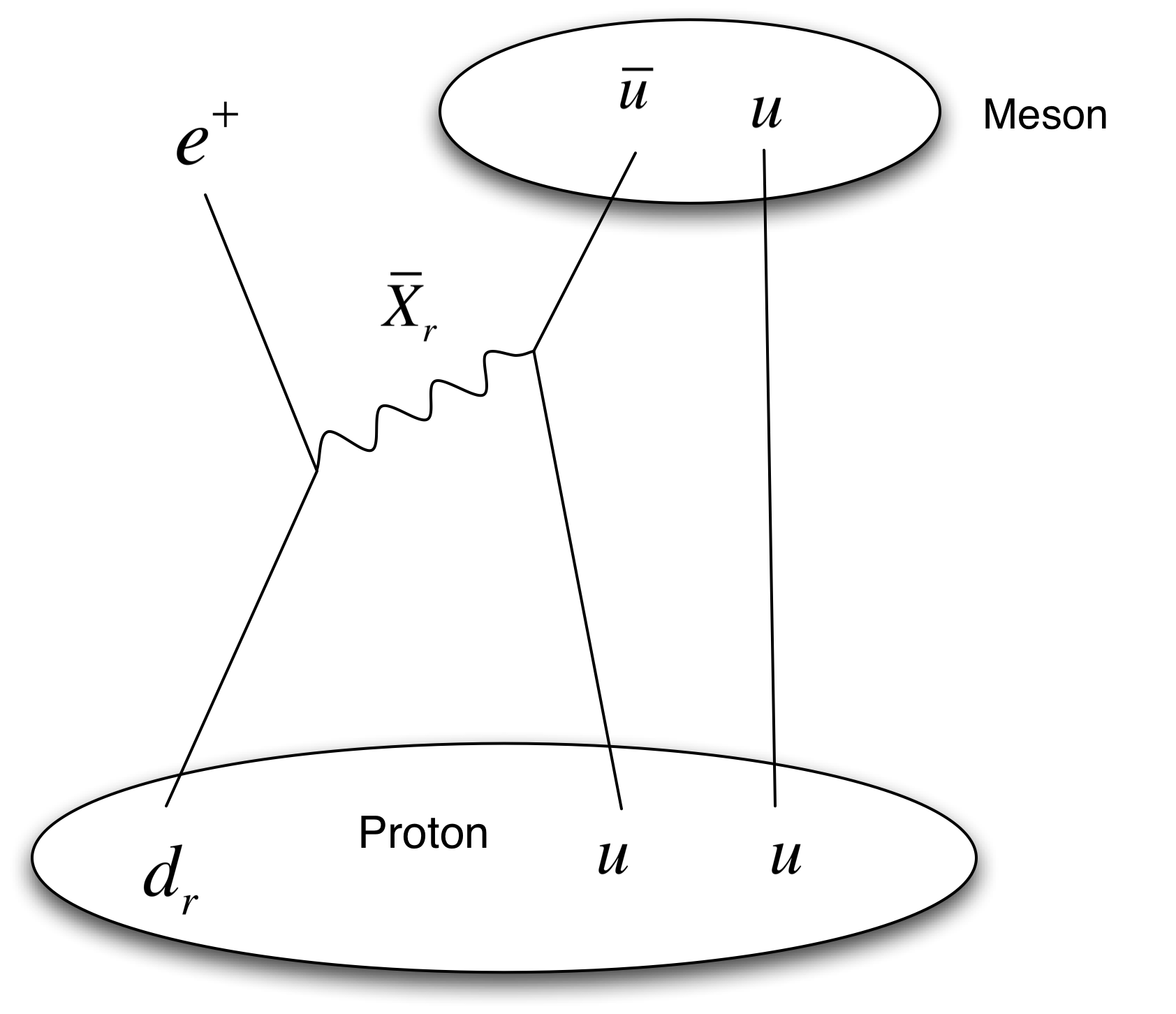
Grand Unified Theories do a dangerous thing – they predict proton decay. We’ve never seen one.
Q: what would the coupling constant be for the X boson?
All the coupling constants end up being the same in GUTs so that won’t save us.
The only thing left to save us is the mass of the bosons. In order to not violate experimental absence of proton decay, which corresponds to a half-life of >> 1033 years, the mass of the X and Y bosons has to be very high – on the order of 1016 GeV. This is interesting because it is getting close to the range where the running coupling constants are appear to cross in value.
The symmetry must be very broken, giving a large mass to the X and Y. A new Higgs like particle is needed to give mass to the X and Y.
When the energy reaches 1018 GeV, which is the unification energy scale, all the particles are effectively massless and the coupling constants go to the same value.
A last comment with respect to Supersymmetry: If you add in all the predicted superpartners, the running coupling constants are computed to cross within 1%, which seems important.