Physics Notes: Supersymmetry,
Grand Unification, and String Theory
Lecture 2: April 5, 2010 Back to PHY31
Question: How will the Higgs be detected in the LHC?
By its decay products. There are required couplings to the Higgs from
fermions. The reverse
applies with the same coupling constants. For technical reasons this will be hard to do. [I suspect that
this is because the same decay products are produced from other processes in
the messy proton-proton collisions.
The presence of the Higgs would have to be deduced from predicted rate
changes with energy levels consistent with the Higgs]
Question: Do left and right handed quarks have the same mass?
Quarks are actually a superposition of left and right handed. Their mass comes from left to right coupling in the Lagrangian terms:

Unlike bosons, fermion graphs with loops that renormalize the mass are all scaled by a power of the coupling constant because they must contain a vertex from the above Lagrangian fragment, which keeps the contributions small. Massless fermions therefore stay massless even after renormalization.
So left and right handed quarks don’t have mass at all, the mass comes from the coupling between them.
Bosons are quadratically divergent – quadratic in
cutoff energy  .
See the boson
renormalization discussion in lecture 1.
.
See the boson
renormalization discussion in lecture 1.
A question is why isn’t the Higgs pulled all the way up the Planck scale by these divergences?
Question: How does inertia arise from the Lagrangian?
First we have the Lagrangian and the resulting wave equation.
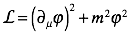
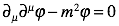 Wave
equation
Wave
equation
If we separate the time and space components:
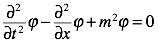 Ignore
y and z
Ignore
y and z
Now substitute a plane wave solution
 into the separated wave equation
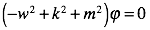 We can assume that
  , so
, so
 but
w is really Energy and k really momentum, so
but
w is really Energy and k really momentum, so

A next step is to show that this implies inertia – left for the class
Question: what does the  term mean in the Lagrangian
At low energies, it is ignored. Higher energies implies that you have a lot of
particles and the  term represents collisions between them – 2
particles coming in and 2 particles going out.
term represents collisions between them – 2
particles coming in and 2 particles going out.
Supersymmetry
Supersymmetry is a very abstract theory. It is difficult to have a physical analogy for what is going on.
Rotations in space
Normally we think of a rotation of  about an axis as returning an object to its original
state. In general this
is not true. A rotation by
about an axis as returning an object to its original
state. In general this
is not true. A rotation by  does return an object to its original state.
Take a box with walls and a ball connected by a set of strings to the walls.
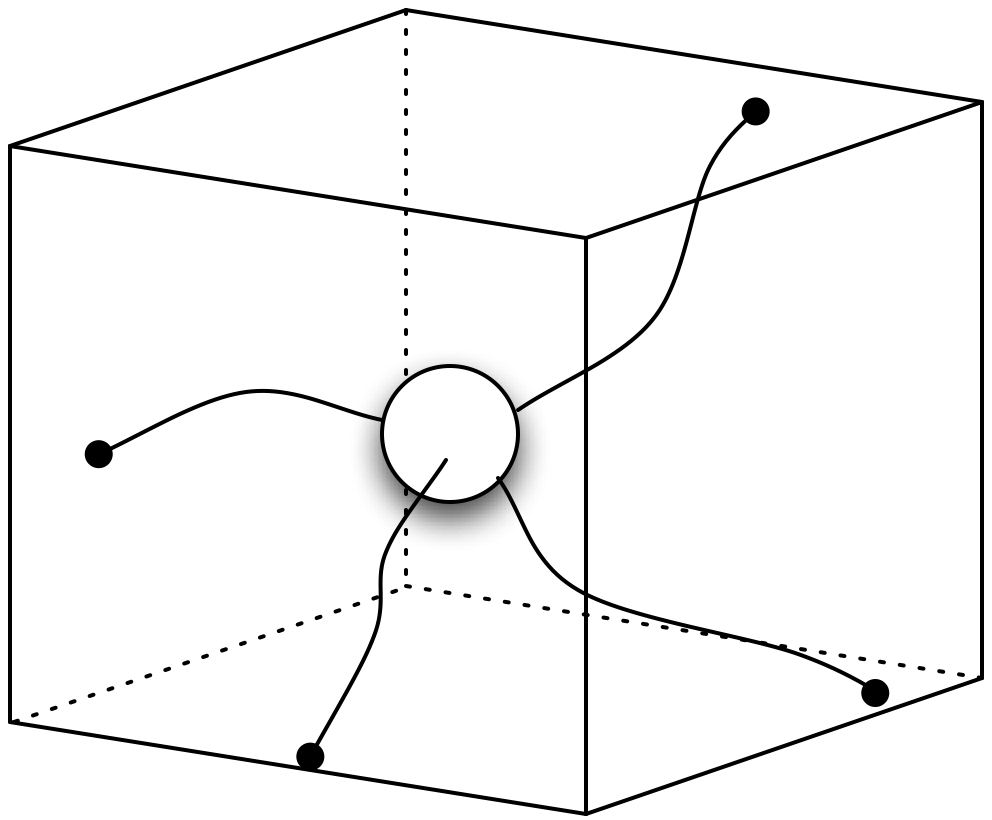
If you rotate the ball by  around some axis while holding the box fixed, the
strings form a tangle that can’t be undone with the ball held fixed. If you rotate it by
around some axis while holding the box fixed, the
strings form a tangle that can’t be undone with the ball held fixed. If you rotate it by  more for a total of
  , then the strings can be untangled and the ball and
string are returned to the original state.
, then the strings can be untangled and the ball and
string are returned to the original state.
Professor Susskind also demonstrated the waitress trick of rotating a glass of water sitting flat on the hand once below the shoulder and once above the shoulder returning to the original state after two full rotations.
I found the following at http://www.physicsforums.com/archive/index.php/t-279123.html - comment by mycen
Roger Penrose suggests the following picture: Put one end of a long belt on the table, under something heavy, and put the other end between two pages in a book. Now rotate this book by 4 pi around the axis defined by the belt. Without rotating the book any further, you can "undo" the 4 pi rotation by looping the belt around the book. This doesn't work with a 2 pi rotation.
Here's one way to understand it.
Let the belt represent the path of the electron through spacetime. The electron
may twist and turn as it travels, but let's say that at certain points, it has
the same orientation it started with. When this happens, the electron must be
in a state related to the original one by some constant factor.
What can this constant be? Well, we need to assign it in such a way that the
state of the electron varies continuously along its path, i.e., no sudden
jumps. Let's say the electron has done two complete rotations since it started.
Can the constant we assign at this point be something besides one?
The belt trick says no. To see why, let's suppose we could make it something
else, say A. Then we've assigned a state to the electron at every point along
the path in such a way that it starts at some state |\psi> and ends at some
state A|\psi>. Now, using the belt trick, we can continuously deform this
path to one where the electron doesn't rotate at all. But we're holding the
ends of the belt fixed, so it still has to start at |\psi> and end at
A|\psi>. But this should be true no matter how short the path is, and when
we take the path to be very small, this means the state must change
discontinuously, unless A=1. On the other hand, a single rotation cannot be so
deformed, so the constant doesn't have to be 1. However, it's restricted by the
fact that doing this twice must return you to the original state, so it must be
either 1 or -1. For an electron, it turns out the constant is -1.
Here's a more technical explanation. The belt is supposed to represent is a
path through SO(3), the group of rotations in 3 dimensions. Namely, each point
along the belt corresponds to a rotation: the rotation that brings that slice
of the belt into its current orientation. So we have a one parameter family of
elements in SO(3), i.e., a path in SO(3). Then by deforming the belt while
holding its two ends fixed, we get a deformation of the path, i.e., a homotopy
of paths. The fact that a twice twisted belt can be deformed to a straight belt
(while a once twisted belt can not) is then just the demonstration that a path
in SO(3) corresponding to a 4pi rotation is homotopic to the constant path
(while a 2pi rotation is not), i.e., that the fundamental group of SO(3) is Z2.
Thus the rotation group is not simply connected, and so it has representations
that are not single valued. For one reason or another, nature chooses to use
one of these representations for certain particles, such as the electron.
If you rotate the spin of a particle by  (can be done by passing through a magnetic field),
then this would modify the particle state by multiplying by a phase Z. If we do this twice then the particle
would be returned to its original state, so
(can be done by passing through a magnetic field),
then this would modify the particle state by multiplying by a phase Z. If we do this twice then the particle
would be returned to its original state, so
 , so
, so  .
.
How can we tell which value of Z is correct for a given particle? How would we detect a value of -1 for Z.
A modified two-slit experiment will do the trick. You need to have single particles in a superposition of rotated and un-rotated states.
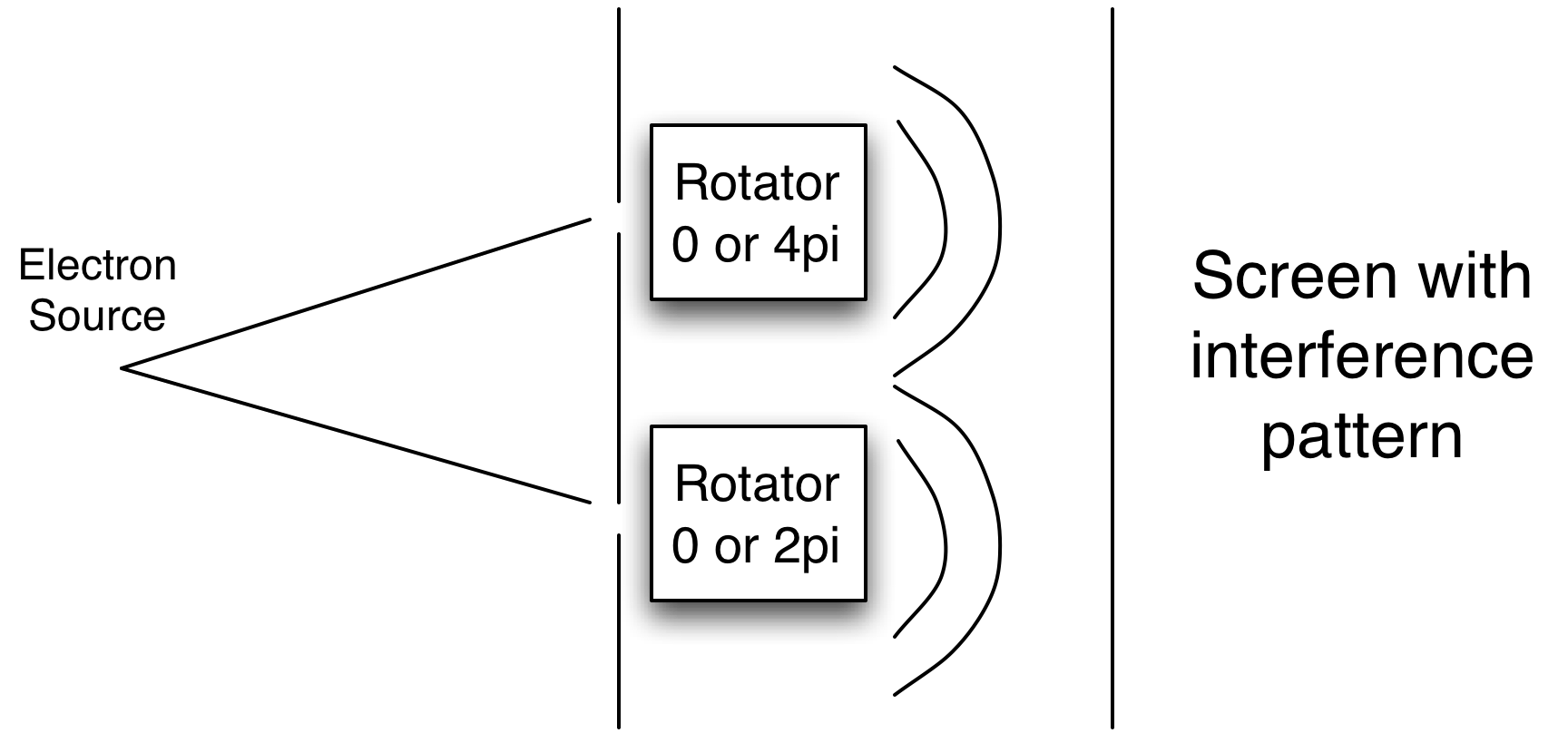
If Z = -1 for a given particle like the electron then
switching the bottom rotator from 0 to  will result in the maxima in the interference pattern
shifting to the positions of the minima before the rotation.
will result in the maxima in the interference pattern
shifting to the positions of the minima before the rotation.
Which particles get Z = -1? It turns out that all fermions get -1 and all bosons get +1. This has been experimentally tested.
Vacuum Loops
Basically we want to find the energy contribution from graphs that have no input or output particles.
Which way is vacuum energy changed by such a graph.
Start with two separated loops:
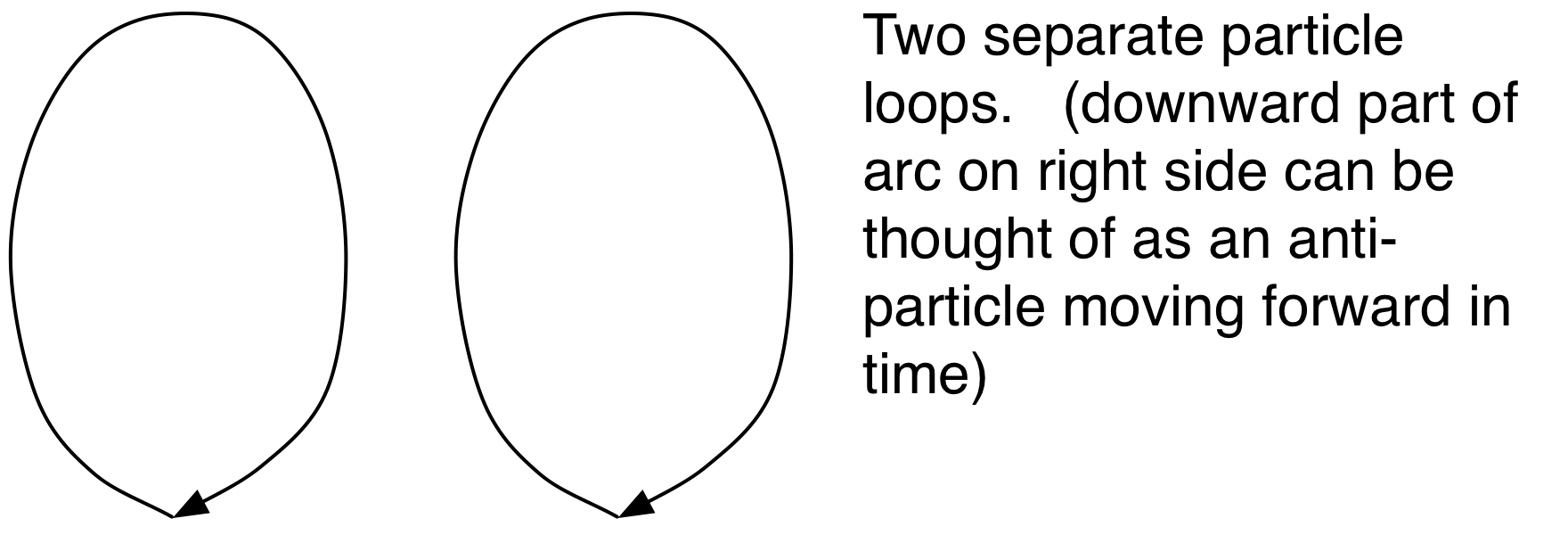
The combined wave function is just the product of the individual wave and always makes a positive contribution. Now put the loops together so they just touch. At the point where the loops touch, you could interchange the particles. In the case of bosons the amplitudes for indistinguishable alternatives add, but in the case of fermions they subtract.
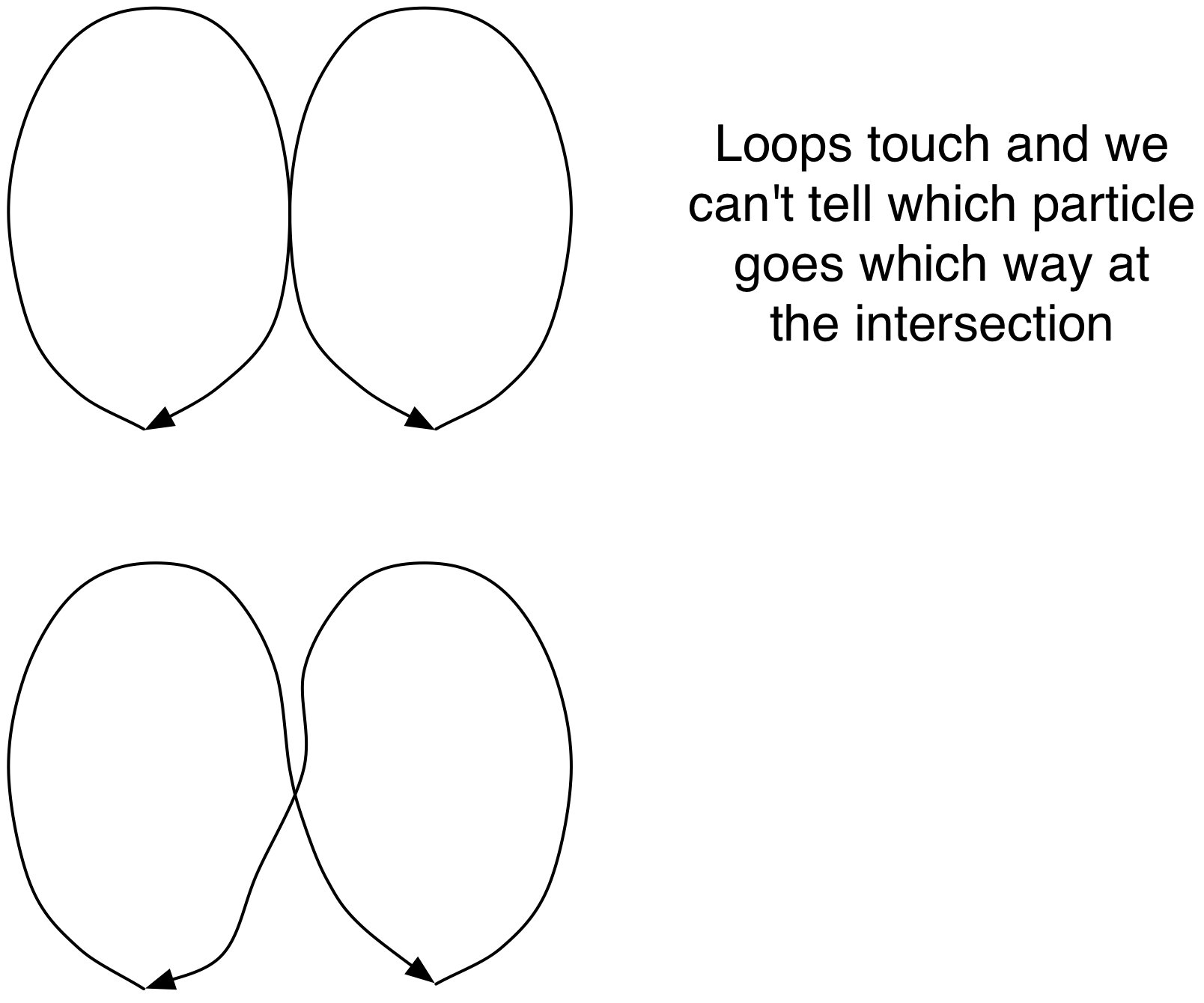
If the fermions cross at the touching point, then the two loops become a single larger loop. If they don’t then you have two loops, which have the original energy contribution. Since the alternatives should cancel each other, the single larger fermion loop must be making a negative contribution.
If every fermion had an equal mass boson partner, then the contributions would cancel out. We don’t see that, and naïve QFT calculations return in an answer 10123 larger than the observed vacuum energy.
This is one of the features of some Supersymmetry theories. However, if the masses matched, then we should see decays into the supersymmetric partners and we don’t.
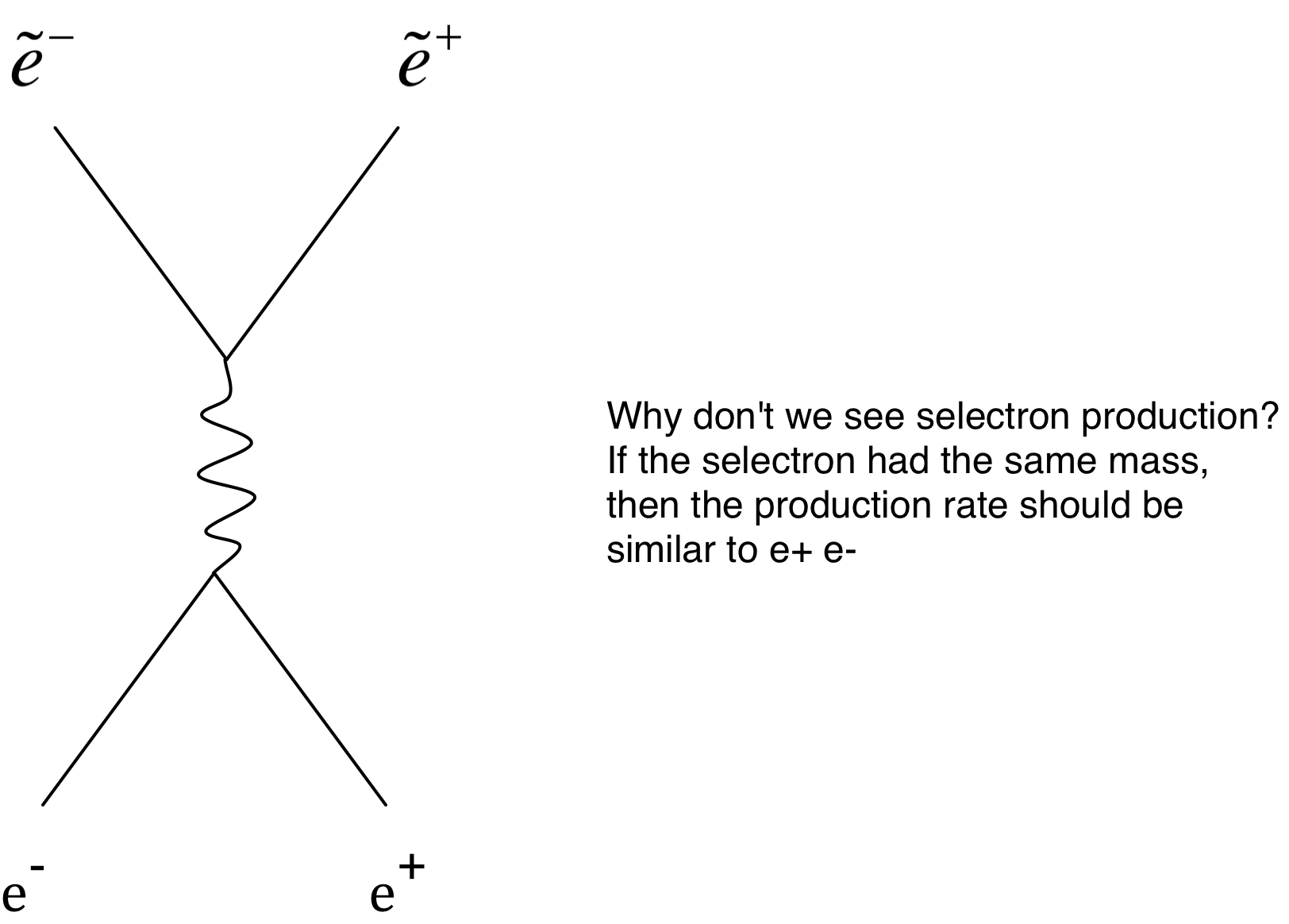
So the partners if they exist must be more massive, greater than 100GeV, but they can’t be too massive or cancellation won’t work well enough. The range of masses has been getting narrower and is in the range of the LHC.
This cancelation would also potentially solve the renormalization problem for bosons including the Higgs and would prevent the Higgs mass being pulled up to enormous mass, and thereby pulling the masses of fermions up as well.
One good way to detect the super partners is by probing higher energies in electron positron collisions. Perhaps 3X the energy of SLAC could do the job. This could be easier because the collision outcomes are simpler than messy proton-proton collisions.
It is expected that the super-partners are unstable with the exception of the lightest one, which might be stable.
Q: How do we know that it is not the coupling constants that make the super-partners hard to detect?
The charges would have to match between for example an electron and a selectron, otherwise, you would get a different set of graphs and a failure to cancel each other out.
Super partners differ by ½ spin, but have the same charge.
Q: (I think posed by Prof Susskind) What would the world be like if it was exactly supersymmetric?
Very different. Take an Li atom which would normally have the bottom shell filled with 2 electrons and would have 1 valance electron in the next shell.
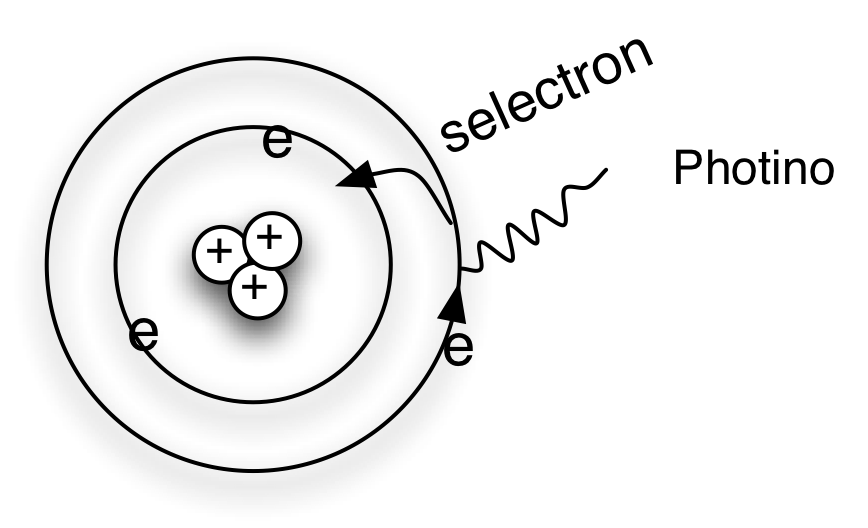
If the outer electron emitted a photino, then it would leave a selectron behind with the same charge. Now the Pauli exclusion principle would not apply to the selectron since it is a boson and the selectron would dive in towards the nucleus. Chemistry certainly wouldn’t work.