Physics Notes: Supersymmetry,
Grand Unification, and String Theory
Lecture 4: April 19, 2010 Back to PHY31
Topics: Symmetry Review, Grassmann Numbers (used to express Supersymmetry)
X-Ray Laser Lecture Question
The last class was cut sort to attend the 2010 Robert Hofstadter Memorial Lecture by Joachim Stöhr about the new X-ray laser at SLAC. During the lecture the statement was made that they wanted to use the X-rays to make movies of atoms or molecules. Prof Susskind asked a question during the lecture - wouldn’t the 4KeV photons just blast the atoms apart? The answer during the lecture didn’t make sense, but it turned out to be a misunderstanding.
Using our favorite units we would have  , so after transfer of that momentum to an electron,
you would add:
, so after transfer of that momentum to an electron,
you would add:

Which is just more than the ionization energy of an electron in the first orbital of hydrogen (13.6eV).
If on the other hand you wanted to take a picture of a molecule, resolving the relative positions of the nuclei, then you would divide by the mass of the atoms, not the mass of the electrons.
On to the lecture…
Review of Symmetry
Symmetries relate the properties of objects in different configurations. A left/right symmetry would say that a left handed (my left hand) would have properties that are the same as a right handed object. Typically, this would include the mass.
A Symmetry can be expressed as an operator on the state of the system.

For the moment we will stick to rotations, but the thinking applies more generally.
For a rotation operator U you need an axis and an angle. Suppose you had two particles in a plane perpendicular to the axis of rotation
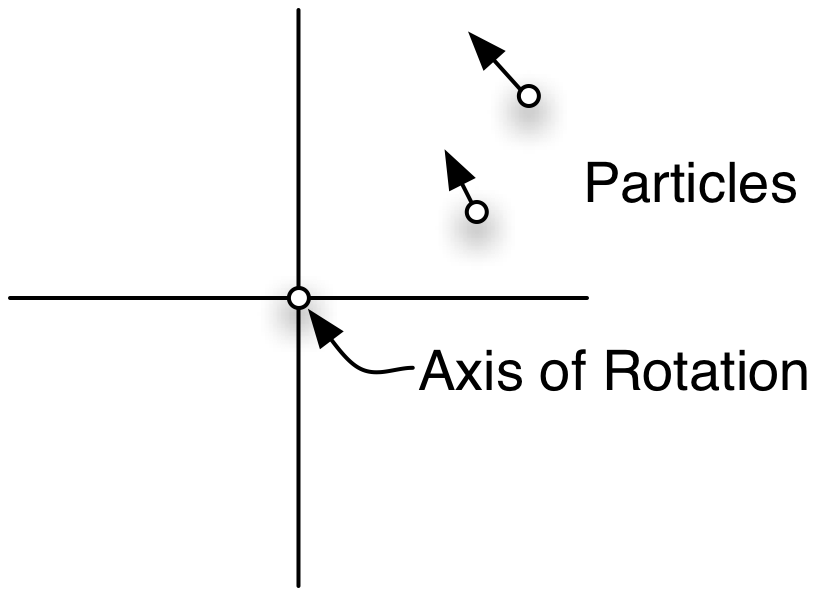
Properties of a Symmetry Operation
 The conjugate transpose is the inverse
This tells us that state vectors maintain their norm (length) under transform.
The set of operators U form a group. All members of the group can be formed as products based on some number of base generators. For 3D rotations, there are 3 such generators.

If  is Hermitian, then
  in the limit is Unitary.
The key to understanding the group is to understand the commutators of the generators.
For rotations:
 [Is this general for N-dimensions? Would be a sum.]
Lets show the connection between the commutator and performing and reversing rotations in different orders. Let

We will also use the fact that U is Hermitian, so that  .
.


We obviously get a term with I. First order terms containing only one
of  cancel as there is one positive and one negative term
for each. We will keep
terms with at most one
cancel as there is one positive and one negative term
for each. We will keep
terms with at most one  .
[I don’t have a good argument for dropping the
.
[I don’t have a good argument for dropping the  terms]

Note the asymmetry in the product where x follows y three times but y follows x one time.


 Using the commutator value
 The
The  term was
just 1.
term was
just 1.
The commutators determine the full structure of the group.
Associated with this symmetry is the angular momentum.
Translations – Changes in Position
Another symmetry.

We use P here because the associated conserved quantity is momentum.
Commutation relations for L and P:



[I’m going to try to prove the last
one. It was just stated in class]
If  , then we are just moving sideways on a cylinder being
rotated back and forth.
These are independent operations so the commutator is 0 and the equation
gives us this because
, then we are just moving sideways on a cylinder being
rotated back and forth.
These are independent operations so the commutator is 0 and the equation
gives us this because  .
.
To make the translation math work out nicely I will add a 4th value to all vectors that always has the value 1. We can use this 1 value to generate the translations. The matrix representations will then be 4x4.
If  , then we can just start with
  . For
small angles of rotation we have (
. For
small angles of rotation we have ( ).
If we put this in our generator form we get.
).
If we put this in our generator form we get.

Then the translation operation must be.

I know that this is not Hermitian. If we insert a  in the
lower left corner, then our constant 1 element in our vectors is
contaminated. One could put a
compensating value in the lower right corner of the matrix, but it would have
to depend on the value of x, which seems odd. It will not affect the commutator
result, so we can press forward.
in the
lower left corner, then our constant 1 element in our vectors is
contaminated. One could put a
compensating value in the lower right corner of the matrix, but it would have
to depend on the value of x, which seems odd. It will not affect the commutator
result, so we can press forward.
Our commutator is then





Which is exactly what we were trying to show.
The General Case
This can be restated more generally using Einstein summation notation.





Notice that the very last term must be 0 because the permutation symbol has two indices equal to 4. After cancelations the last term in the first group is all that is left.

Breaking out the  and swapping indices on the permutation symbol we have

Notice that the permutation symbol requires  to be the
coordinate not equal to i or j, so this matches the representation of
to be the
coordinate not equal to i or j, so this matches the representation of  . We can
also drop coordinate index 4 here since we are only interested in the behavior
of the operators and 4 is guaranteed to be after the other coordinate indices hence
it doesn’t affect the sign of the permutation symbol.
. We can
also drop coordinate index 4 here since we are only interested in the behavior
of the operators and 4 is guaranteed to be after the other coordinate indices hence
it doesn’t affect the sign of the permutation symbol.

[Back to the lecture …]
Energy and Symmetry
Energy should not change when you perform a symmetry operation.
Lets take a state of energy E
 E
is an eigenvalue of H
E
is an eigenvalue of H
The symmetry operation doesn’t change the energy, so …

 the
first E is just an eigenvalue
the
first E is just an eigenvalue
 E
was an eigen value of H after all
E
was an eigen value of H after all
This means that

Operators that commute with H measure values don’t change with time and are therefore conserved. Now this is true for all eigenvalues of H, which forms a basis for all states. Therefore the conservation is general, not just for eigenvectors.
Transforming Between Fermions and Bosons
Imagine that there is a symmetry represented by Q between Fermions and Bosons.

We can try to build Q from the creation and annihilation operators for bosons and fermions.
 is the
creation operator for bosons and
is the
creation operator for bosons and  is the annihilation operator
 is the creation operator for fermions and
  is the
annihilation operator
is the
annihilation operator
To remove on boson and add one fermion we would use

If we apply this to a state with a fermion it yields 0, so it isn’t our operator yet.
We could use

One of the two terms will produce 0 and the other will perform the exchange.
To make it clear, if you apply an annihilation operator to a vacuum you get 0 and a creation operator then has no effect.
Now Fermions and bosons have different numbers of components, so you actually need multiple Q’s

Prof Susskind mentioned that the  operators
have an odd number of fermion operators.
[I’m not sure what that means and he didn’t
expand on it]
operators
have an odd number of fermion operators.
[I’m not sure what that means and he didn’t
expand on it]
Reviewed commutation relations for boson operators and anticommutators for fermions.



These relationships tell us what happens when particles are exchanged.

but

A comment was that boson fields behave classically because you get large numbers of particles that can be modeled as a continuous density. You never get more than one fermion in a state, so the behavior is more discrete.
Grassmann Numbers
Before going to the formulation of Supersymmetry, we need to add Grassmann numbers to our toolbox. We need a type of number that anticommutes to simplify the formulation for fermions.
We will use  for ordinary numbers and
  for Grassman numbers. Ordinary numbers commute and Grassman numbers
anticommute.
for Grassman numbers. Ordinary numbers commute and Grassman numbers
anticommute.

Which says that Grassman numbers are closed under addition and multiplication, and can be scaled by multiplication by an ordinary number.
Anticommutation says that

Which tell us that

From this we can prove a simple fact about powers of Grassmann numbers.

This limits the space of functions of one Grassmann number to
 Higher
order terms in
Higher
order terms in  must be 0
For functions of two Grassmann numbers
 Higher order terms have squares
Exponential functions of Grassmann numbers don’t follow the normal rules of exponentials

but

Integration and Differentiation of Functions of Grassmann Numbers
Basics:

When two variables are involved there is a small complication

and with the other variables you get

The minus sign difference comes from swapping the  to the front of the last term before taking the
derivative. You can get the
right sign by counting the number of swaps needed to move the target variable
to the front.
to the front of the last term before taking the
derivative. You can get the
right sign by counting the number of swaps needed to move the target variable
to the front.
The product and chain rules work.