Physics Notes: Supersymmetry,
Grand Unification, and String Theory
Lecture 5: April 26, 2010 Back to PHY31
Topics: Supersymmetry
Question: How many particles are there given Supersymmetry?
We don’t know how many particles there are without it. Undiscovered particles must either have a big mass, or a small coupling constant. There are examples of particles that we predict like this. Two are the gravitron and the axion. Such particles can’t be charged or we would have detected them.
Question: Are there alternatives to Supersymmetry, given that the remaining range of permissible masses are covered by the LHC?
For the Higgs, the maximum mass needs to be less than 1Tev. Above that, Supersymmetry may still exist, but it would not solve the mass hierarchy problem.
One alternative, Technicolor, appears to violate measurements in high precision experiments involving the Z.
Question: What evidence is there for vacuum energy other than the Casmir effect?
The Casmir effect is really just a force between conductive
plates. Susskind’s
view is that vacuum energy is the energy of empty space that drives the
expansion of the universe.
[With the exception of gravity, physics appears
to be driven by differences in energy. For gravity, the energy contribution to the
stress energy tensor is not a difference. When space is expanded, the new space has to have that
vacuum energy too, which requires work. ]
Question: What is the string coupling constant?
The string coupling constant is not that different from e.
Strings are very stiff [as in their spring constant]. If you could attach the “string” connecting protons and neutrons to a truck, you could lift the truck with one such string. Fundamental strings are much stiffer – you could lift the galaxy in a 1G field.
Lecture – Supersymmetry
Professor Susskind expressed his doubt that the lecture would work due to the abstractness of the subject.
One More Pass at Grassmann Numbers
We will use either  to represent Grassmann numbers. Other numbers will be ordinary
complex numbers.
to represent Grassmann numbers. Other numbers will be ordinary
complex numbers.
If our functions involve an even number of Grassmann
numbers, then it is often convenient to represent them as a conjugate
pair. In which case you will
see the pair replaced by  .
.
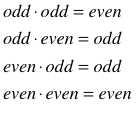
We will classify numbers, variables and functions of those variables as “even” or “odd”. Ordinary numbers are “even”. Grassmann numbers are “odd”. The product rule for even/odd is:
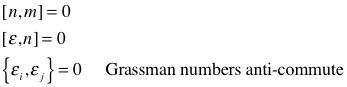
We also want need the commutation rules for Grassmann and ordinary numbers:
We can express functions of Grassmann numbers as a power series,
which terminates almost immediately because  .
.

Alternatively we could use  to
represent a pair, and then the function would look like:
to
represent a pair, and then the function would look like:

If a function is even or odd, then the terms in the polynomial have to have the same even/oddness.
Last – Integration and differentiation with respect to a Grassmann variable is defined and you can figure out the behavior from the polynomial expansion of the function and the even or oddness of the function.

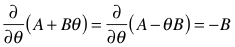
If F is an even function, then B would have to be odd, then:
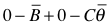
Another example of a function we designate as even:
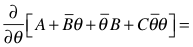 B is
odd, C is even
B is
odd, C is even
The Commutator of a Derivative with Multiplication by the Variable
For ordinary variables we have the result:
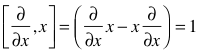 You can prove by
applying to F(x)
You can prove by
applying to F(x)
This result depends on the product rule for derivatives.
The product rule for derivatives works for functions of
Grassmann numbers as long as the even/odd rules are followed. If  below is odd then the second term
of the product rule will be negative.
below is odd then the second term
of the product rule will be negative.

To evaluate our commutator, we take the product rule case
where  is
odd.
is
odd.
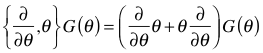
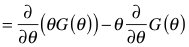
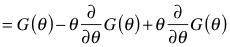
Note the sign of middle term after  moves
across
moves
across  in the product rule expansion.

Therefore:
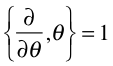
Symmetry Group Review
Focus on continuous groups. The structure of the group also known as the Lie Algebra is completely determined by the generators and the commutation relations.
 (
( here is not a Grassmann number)
The commutation relations have the form
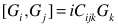
 are the structure constants of the group
 is anti-symmetric under swap of
  and
and  .
.
The  ’s are Hermitian and can therefore represent
observables.
’s are Hermitian and can therefore represent
observables.
Take  which are generators for rotational symmetry and
correspond to the angular momentum observables.
which are generators for rotational symmetry and
correspond to the angular momentum observables.
We sometimes combine the generators to form new operators. For example:
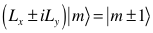
Which are the raising and lower operators for the quantum harmonic oscillator.
Also, when you have a real symmetry, it doesn’t change the energy, so

Which also tells us that the time derivative of the observable must be 0.
Suppose we have an operator involving Grassmann numbers. Measureables must be “even” functions, just as we require measureables to be “real”.
For reference, boson and fermion commutation relations are
Boson: 
Fermion: 
Combined: 
Our fermion raising and lower operators are “odd”. Boson raising and lower operators are “even”.
Particles have mass m, so

 Delete
fermion, add boson
Delete
fermion, add boson
 Delete
fermion, add boson
Delete
fermion, add boson
What is the
commutation relation between  ?
?

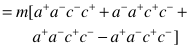
We took advantage of the commutation relations to separate the a’s and c’s. The second line here totals to 0. Summing vertically we get:

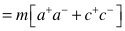
But we recognize these two operators as population counting operators for bosons and fermions. Since all our particles have the same mass, this is an expression for the energy. So:

But this means that the symmetry operators swapping bosons
with fermions are not closed.
We at least have to add  to the set of generators.
Now, Q is odd and H is even, so we know that
 and
and 
Therefore  measure conserved quantities.
Having H is the group is strange.
Remember that:
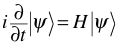
This tells us how to move in time (evolve  ) by delta time
  .
.
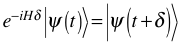
How do we think about  ?
?
As coordinate shifts by Grassmann coordinates.
Take a function
 .
.
This function represents the amplitude to find the particle
at  .
.
Now  gives us

Now lets simultaneously vary both  and
and  in a
funny way:
in a
funny way:
 and
and 
Notice the order of the terms in the t translation.
[In class Susskind had  , but I am going to flip the order of the last term to
correct a sign error that shows up at the end]
, but I am going to flip the order of the last term to
correct a sign error that shows up at the end]
This is pretty strange, changing time by a Grassmann number
product, but it does remain even
because of the product of  and
and  .
.

Regrouping a bit we get

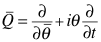
But the term in ( ) is just Q!!!
We can get  with a swap of
  for
for  . [In class there was a sign change for the
  term, but
this is wrong because space or time derivatives of a wave function are
anti-Hermitian, so the whole term is actually real – no sign change when
you take the conjugate. Or
you could look at it as changing the sign of the
term, but
this is wrong because space or time derivatives of a wave function are
anti-Hermitian, so the whole term is actually real – no sign change when
you take the conjugate. Or
you could look at it as changing the sign of the  and the sign of the derivative, which would cancel. If you do change the sign, then
the commutator vanishes, which Susskind says is important, but I got distracted
and forgot to ask why. I
added a section to the end of the notes showing what happens when you flip the
sign]
and the sign of the derivative, which would cancel. If you do change the sign, then
the commutator vanishes, which Susskind says is important, but I got distracted
and forgot to ask why. I
added a section to the end of the notes showing what happens when you flip the
sign]
Testing the commutator 
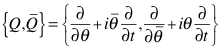


Derivatives by Grassmann variables are odd so when we swap them in a
product we have to change the sign.
This will cause the first terms in each group to cancel against each
other. The last terms will
cancel because the sign flips when we order the variables. The simplified equation is:

Reorganizing:

Swapping terms around to find anti-commutators that we know are just 1.

We now replace the anti-commutators with their known values.


So moving around in  requires
moving around in time.
requires
moving around in time.
Curved space versions of this get even more complex. These versions are known as
supergravity.
Commutator with Reversed Sign for  –
Just for Fun
–
Just for Fun
[As of lecture seven we now know
 as
as  ]
]
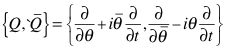


Derivatives by Grassmann variables are odd so when we swap them in a
product we have to change the sign.
This will cause the first terms in each group to cancel against each
other. The last terms will
cancel because the sign flips when we order the variables. The simplified equation is:

Reorganizing:

Swapping terms around to find anti-commutators that we know are just 1.

We now replace the anti-commutators with their known values.
