Physics Notes: Supersymmetry,
Grand Unification, and String Theory
Lecture 7: May 17, 2010 Back to PHY31
Topics: Superfields, Preserving Supersymmetry in Lagrangians
Questions
Q: What is the mass of the lightest Supersymmetric partner?
It needs to be < 1TeV to be a good dark matter particle.
Q: Can’t Fermilab reach 1TeV
If you were banging two 1TeV electrons together, then yes. If you are banging protons together, then each quark can be thought of as carrying 1/3 TeV, with messy collisions that rarely extract all the energy.
Q: What was the motivation for Supersymmetry?
It turned up in the math of String Theory as formulated in approximately 1972, but it was not recognized at first. The first string theory had bosons. Later when fermions were added, Supersymmetry was added as a side effect but not recognized.
Bruno Zumino found it in the math of string theory. In 1980 the connection was made to the renormalization problem.
Lecture
Let’s return to a model of fermions and bosons at rest.
We have our standard creation and annihilation operators
 create and annihilate a boson
 create and annihilate a fermion
Boson Field and Lagrangian
The boson field will be  .
.
Out of it we construct a Lagrangian, which could look like:
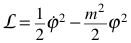
From this we can use the Euler-Lagrange equation to get the equations of motion.
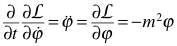
Which we recognize as a harmonic oscillator of frequency  .
.
Fermion Field and Lagrangian
The fermion field will be  .
.
If we create a simple Lagrangian

Then the equation of motion would look like
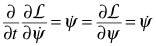
Which is information free! Now if we treat fermion fields as Grassmann numbers we get a different result.
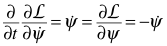
So

Which at least says something.
For bosons  was
the restoring force. For
fermions we have to split into left and right-handed fields with the mass term
coupling them together.
was
the restoring force. For
fermions we have to split into left and right-handed fields with the mass term
coupling them together.

If this were a boson field, the result would be trivial. Treating the field variables as Grassmann numbers changes the story.

The minus sign courtesy of swapping  left over
  .
.
Likewise:

Simplifying, we have:

Now we can combine the Lagrangians:

Note that there are no interactions between the boson and fermion
fields.
Review of Boson/Fermion Symmetry Operations
[Note the change here to use  in
the definitions. I suspect the
reason for this is that the norm of a complex Grassmann variable
in
the definitions. I suspect the
reason for this is that the norm of a complex Grassmann variable  is
is  . So putting in the
  here
makes this definition of the transforms match the coordinate transform
definition, which uses Grassmann variables.]
here
makes this definition of the transforms match the coordinate transform
definition, which uses Grassmann variables.]
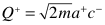 Delete fermion, add boson
 Delete fermion, add boson

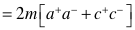 [Lecture
5 shows how to derive this]
[Lecture
5 shows how to derive this]

This last bit we can recognize as the mass times the population count
of the bosons and fermions.
This is the total energy.
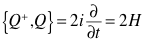
The other commutation rules involving Q and H are:


 - Whatever
  measures,
it is conserved.
measures,
it is conserved.
 are supercharges. Q can be used as a basis for
states.
are supercharges. Q can be used as a basis for
states.
The Coordinate Transform Version of Q
Note: time and space derivatives of fields are anti-Hermitian. You should think of them as pure imaginary when conjugating an expression involving them.
We add two conjugate Grassmann variables  and
and  to
our normal coordinate
to
our normal coordinate  .
.
We can then define  in terms of them.

We can then show that [see derivation in lecture 5]
A Superfield

We can make a Lagrangian out of our superfield in something like the usual way with squares and derivatives of the field. The Lagrangian

will also have a Taylor’s series expansion:
From this we can form the action:

When you integrate it out with respect to  and
and  ,
you always get the highest order term from the Lagrangian. Check the integration rules from
Lecture 6.
,
you always get the highest order term from the Lagrangian. Check the integration rules from
Lecture 6.
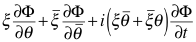
Now we are ready to try the coordinate transform:

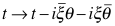
When you have a small displacement you simply add the sum of
the derivatives times the displacements. [Small is a funny word here when Grassmann variables are
involved.]



Building Lagrangians That Preserve Supersymmetry
When we write Lagrangians for relativistic theories, we have a formalism with tensors that results in a Lagrangian that is a scalar – the same in all reference frames. This automatically preserves all the relativistic symmetries.
We need the equivalent for Supersymmetry.
First – what works and what doesn’t work?
You can square a superfield:


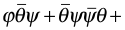
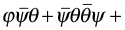

Sorting variables into the same order and combining:

This Lagrangian term is ok because it is built out of  which
we already know has the symmetry.
What about the kinetic terms? We can’t just use a time derivative
because that will break the symmetry.
which
we already know has the symmetry.
What about the kinetic terms? We can’t just use a time derivative
because that will break the symmetry.
[Why is that?
Suppose:
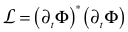


The part that will contribute to the action will be the  part, so we don’t need to get the rest.

Rearranging:



Interesting – each pair is a pair of conjugates, if we
subtract in this order, then we get -2 times the imaginary part, so we have a
pure imaginary number.
Normally, with  we would have the product of two
imaginary numbers from the time derivatives, which would be real. Something is already broken
– courtesy of the Grassmann variables!
we would have the product of two
imaginary numbers from the time derivatives, which would be real. Something is already broken
– courtesy of the Grassmann variables!
End – back to lecture]
[I think the idea in this next
section is that if you have a constraint operation D that commutes with the
symmetry generators, that you can derive from it a variable substitution,
expressing the equivalent constraint. This makes me think of covariant derivatives like in
gauge invariance or in GR]
Suppose that you have a symmetry – for example a
rotational symmetry for vector field 
A symmetry has a set of generators – just one in this case

Suppose we have a linear constraint operator D (containing derivatives + stuff) such that:

This constraint can be thought of as a constraint on the input
arguments x and y, specifying a relationship between them that makes the
constraint true
Since  has rotational symmetry, we would like to show that
 which corresponds to a small rotation
Which would mean that our constraint holds after transform:

If D and R commute or anti-commute, then:

So if D and R (or our symmetry generators in general) commute, then application of D will preserve the symmetry.
In Supersymmetry the symmetry generators are  ,
,
 ,
and
,
and  .
.
Let
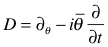 and
and 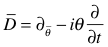
You can check that the anti-commutator  here.
here.
We require the constraint to be invariant to transformation by Q.
 minus sign from
anti-commutator
minus sign from
anti-commutator
A superfield that obeys this constraint is known as a Chiral superfield.
The corresponding variable substitution is:
 [I tried it this way and didn’t get cancelations]
[This next bit is my experiment -

[I should really change the last term from using D to
avoid confusion]
And we write out the superfield in terms of  ,
,  , and
, and  .
.

Expanding each of the terms with a Taylor series:

Now apply
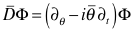

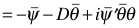
And the conjugate is then:

Now we can combine them to form a term for a Lagrangian.

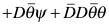

Assuming that this is a term in the Lagrangian the  terms
would survive in the action, leaving:
terms
would survive in the action, leaving:

Order changes sign



Ok, so at least our result is
real. I’m not sure quite
what this means. It is very
strange that  disappeared.
It seems like the constraint would also tell us that
disappeared.
It seems like the constraint would also tell us that  is zero, so:

End of experiment]
The punch line is that with Lagrangians formed this way that divergences disappear.